Ultimate Mortal Kombat 3
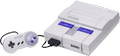
1.1M plays 1996 #Action#Fighting
Ultimate Mortal Kombat 3 is a one-on-one fighting game developed by Avalanche Software and published for the SNES in 1996. It is a conversion of Midway's 1995 arcade game, itself an expanded revision of Mortal Kombat 3 released earlier that year. The story continues Shao Kahn's invasion of Earthrealm, bringing its warriors together for another tournament against the emperor and his Outworld forces. The home version was built from the code of the preceding SNES conversion of Mortal Kombat 3 rather than being a direct copy of the arcade program, so it combines much of the Ultimate update with several additions and compromises of its own.
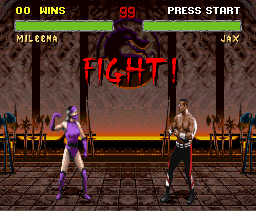
The basic design remains recognisably Mortal Kombat. Two fighters face one another in short rounds, using punches, kicks, blocks, special attacks and the series' characteristic finishing moves. The run button and energy meter introduced in Mortal Kombat 3 encourage aggressive play, while preset chain combinations allow long sequences of attacks once their timing has been learned. Uppercuts can send opponents through the ceiling of certain arenas, and victorious players may finish a match with Fatalities, Babalities, Friendships, Stage Fatalities or the newly added Brutalities.
The expanded roster is the principal attraction. Scorpion, Reptile, Kitana and Jade return after being absent from Mortal Kombat 3, while Mileena, Ermac and Classic Sub-Zero are immediately selectable instead of requiring the arcade game's Ultimate Kombat Codes. Rain and Noob Saibot become playable fighters for the first time, and Human Smoke remains a hidden character. Motaro and Shao Kahn can also be unlocked for two-player matches, although the four-armed Sheeva was removed from both 16-bit conversions.
Several modes extend the game beyond its normal single-player ladder and direct two-player battles. A two-on-two option recreates the endurance-style matches with human-controlled teams, while Tournament mode organises competition for as many as eight participants. The Master ladder restores battles against several consecutive opponents, and completing the main game or tournament grants access to Shao Kahn's Lost Treasures. Kombat Kodes and concealed option menus alter rules, reveal secrets and reward experimentation.
The presentation retains the series' digitised actors, copious blood and dark mixture of martial arts, fantasy and black humour. New locations such as Scorpion's Lair, Jade's Desert and Kahn's Kave accompany familiar material from Mortal Kombat 3, while the soundtrack and sampled voices attempt to reproduce the arcade atmosphere within 16-bit cartridge limits. The conversion is not arcade-perfect, but the large cast, fast pace and wealth of secrets make it one of the most substantial traditional fighting games available for the system.
The SNES edition contains only seven arenas, and two of them—the Rooftop and Pit 3—must be reached through cheat menus. Cartridge limitations also removed character-name announcements, Sheeva and the arcade game's Animalities, while several finishing moves were simplified. Unlike the Genesis version, however, Mercy remains available, and the console's stronger colour and sound capabilities provide cleaner sprites, fuller music and more convincing sampled voices. Its hidden menus also offer an unusually large selection of cheats and viewing options.
Contemporary reviews generally admired the ambition of fitting so many characters, moves and secrets into a 16-bit cartridge, although critics also observed that buyers had received Mortal Kombat 3 only a year earlier and that the newer Mortal Kombat Trilogy offered still more content on other hardware. The SNES port is therefore best understood not as a perfect preservation of the arcade machine, but as a distinctive home adaptation. Its omissions are evident, yet the responsive combat, expanded selection of fighters and strong local multiplayer helped establish Ultimate Mortal Kombat 3 as a favourite among players of the classic two-dimensional series. It also forms an effective culmination of the style introduced by Mortal Kombat and refined in Mortal Kombat II.
Text: RetroGames.cz, licensed under CC BY-SA 3.0
Keyboard controls
| SNES | Player 1 | Player 2 |
|---|---|---|
| D-pad | ↑↓←→ | IKJL |
| A | Z | M |
| B | X | N |
| X | A | U |
| Y | S | H |
| L | Q | Y |
| R | E | O |
| Select | Shift | B |
| Start | Enter | Space |
Hotkeys
- 1 Quick save state
- 2 Quick load state
- 3 Change save slot
Gamepads are detected when you press a button. Remap any key from the emulator’s Controls menu (gear icon).
Online, both players use the Player 1 keys (or a gamepad) on their own computer. Saving, loading and pausing are off while you play online.
Live chat
Connecting…
Keyboard controls
| SNES | Player 1 | Player 2 |
|---|---|---|
| D-pad | ↑↓←→ | IKJL |
| A | Z | M |
| B | X | N |
| X | A | U |
| Y | S | H |
| L | Q | Y |
| R | E | O |
| Select | Shift | B |
| Start | Enter | Space |
Hotkeys
- 1 Quick save state
- 2 Quick load state
- 3 Change save slot
Gamepads are detected when you press a button. Remap any key from the emulator’s Controls menu (gear icon).
Online, both players use the Player 1 keys (or a gamepad) on their own computer. Saving, loading and pausing are off while you play online.
Play online
Play with a friend on another computer. Host a room and send them the link; they join as Player 2 and you both see the same game.
Press Start Game first.
Comments