Tetris 2
117K plays 1993 #Puzzle
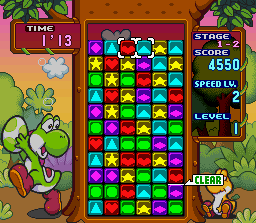
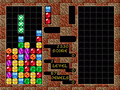
Tetris 2 (released in Japan as Tetris Flash) is a 1993 puzzle video game developed and published by Nintendo for the NES, Game Boy, and Super Nintendo Entertainment System. Conceived as a variation on the traditional Tetris formula, the game replaces line-clearing mechanics with colour-matching rules more reminiscent of Dr. Mario. Instead of focusing on forming horizontal lines from falling tetrominoes, the player matches the colours of descending irregular block clusters to fixed blocks already on the playfield. When three or more blocks of the same colour align vertically, horizontally, or diagonally, they disappear, gradually clearing the board.
The game introduces preset “flash blocks” on the playfield, which serve as targets the player must eliminate to finish a level. Tetris 2 features differently shaped block clusters compared with classic tetrominoes, and these pieces fall individually rather than in continuous waves. This design gives the game a more puzzle-oriented feel, emphasising board management and careful planning over reflex-driven line stacking. Difficulty increases with each stage as the speed rises and the initial layouts present trickier colour combinations.
Critical reception to Tetris 2 was mixed. Contemporary reviewers often praised its attempt to refresh the Tetris brand, noting that the colour-matching system added a strategic layer distinct from the original game. Some critics highlighted the game’s accessibility and its suitability for younger or more casual players, pointing out that its mechanics were less punishing than line-based Tetris. The multiplayer mode, which allows two players to compete by clearing colours faster than their opponent, was generally well received for adding replayability.
However, several reviewers remarked that the game lacked the elegance and depth of classic Tetris, arguing that the colour-matching mechanic diluted the purity of the original’s design. Others noted that the reliance on preset colour patterns made the game feel closer to a Dr. Mario variant than a true Tetris sequel. Critics also pointed out that the visual presentation and sound design, while competent, did not significantly advance the series’ identity.
Despite its divided critical response, Tetris 2 remains a notable entry in Nintendo’s puzzle-game library. Its attempt to hybridise Tetris-style falling blocks with colour-matching puzzle mechanics marks it as an experimental offshoot of the franchise. While it did not achieve the iconic status of its predecessor, the game is remembered for offering an alternative interpretation of the Tetris formula and for expanding Nintendo’s early-1990s catalogue of accessible, family-friendly puzzle titles.
Text: RetroGames.cz, licensed under CC BY-SA 3.0
Keyboard controls
| SNES | Player 1 | Player 2 |
|---|---|---|
| D-pad | ↑↓←→ | IKJL |
| A | Z | M |
| B | X | N |
| X | A | U |
| Y | S | H |
| L | Q | Y |
| R | E | O |
| Select | Shift | B |
| Start | Enter | Space |
Hotkeys
- 1 Quick save state
- 2 Quick load state
- 3 Change save slot
Gamepads are detected when you press a button. Remap any key from the emulator’s Controls menu (gear icon).
Online, both players use the Player 1 keys (or a gamepad) on their own computer. Saving, loading and pausing are off while you play online.
Live chat
Connecting…
Keyboard controls
| SNES | Player 1 | Player 2 |
|---|---|---|
| D-pad | ↑↓←→ | IKJL |
| A | Z | M |
| B | X | N |
| X | A | U |
| Y | S | H |
| L | Q | Y |
| R | E | O |
| Select | Shift | B |
| Start | Enter | Space |
Hotkeys
- 1 Quick save state
- 2 Quick load state
- 3 Change save slot
Gamepads are detected when you press a button. Remap any key from the emulator’s Controls menu (gear icon).
Online, both players use the Player 1 keys (or a gamepad) on their own computer. Saving, loading and pausing are off while you play online.
Play online
Play with a friend on another computer. Host a room and send them the link; they join as Player 2 and you both see the same game.
Press Start Game first.

Comments