Tetris
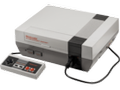
4.8M plays 1989 #Puzzle
Tetris is a puzzle game developed and published by Nintendo for the Nintendo Entertainment System in 1989. It is based on the original game created by Soviet programmer Alexey Pajitnov in 1984, but should not be confused with either the earlier Japanese Famicom version from Bullet-Proof Software or the competing NES adaptation released by Atari Games under its Tengen label. Nintendo's edition was created after a complex dispute over the home-console rights to Tetris and ultimately became the officially licensed version sold for the NES.
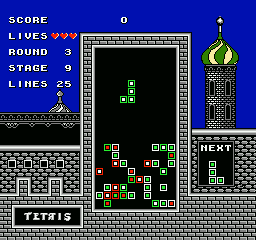
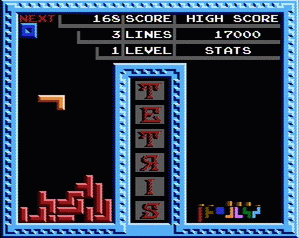
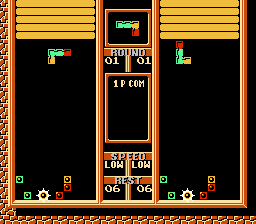
The player must arrange a continuous sequence of seven differently shaped tetrominoes inside a well measuring ten squares across and twenty squares high. Pieces can be moved horizontally, rotated and accelerated as they fall, but cannot be exchanged or stored for later use. Completing a horizontal line removes it from the board and awards points, with increasingly large bonuses granted for clearing two, three or four lines simultaneously. The game ends when the accumulated blocks reach the top of the playing field and a new piece can no longer enter.
Two single-player modes are available. A-Type is an endurance game in which the player attempts to achieve the highest possible score while the falling speed increases as additional lines are cleared. The starting level can be selected before play begins. B-Type instead challenges the player to clear 25 lines from a board that can already contain several rows of randomly arranged blocks. Both the initial speed and the height of this starting obstruction can be adjusted, allowing the mode to provide a series of increasingly difficult short challenges.
The presentation is simple but effective, with clearly distinguished pieces, a preview of the next tetromino and statistics showing how many examples of each shape have appeared. Players can choose from three background melodies or play without music. Successful A-Type games are rewarded with animations depicting different rockets being launched, while completing the more difficult B-Type settings produces performances by familiar Nintendo characters. Unlike the Game Boy version, the NES release contains no two-player mode, a limitation that was particularly noticeable beside the recalled Tengen edition.
Although initially criticized for offering fewer options than Tengen's version, Nintendo's Tetris became one of the most enduring competitive games on the NES. Its fixed rules, demanding high-speed play and emphasis on efficient scoring made it particularly suitable for record attempts and organized tournaments. Decades after its release, players developed advanced techniques such as hypertapping and rolling to control pieces at speeds once considered impossible. The game consequently gained a new competitive life and remains one of the most important adaptations of Pajitnov's original design.
Text: RetroGames.cz, licensed under CC BY-SA 3.0
Keyboard controls
| NES | Player 1 | Player 2 |
|---|---|---|
| D-pad | ↑↓←→ | IKJL |
| B | Z | N |
| A | X | M |
| Select | Shift | B |
| Start | Enter | Space |
Hotkeys
- 1 Quick save state
- 2 Quick load state
- 3 Change save slot
Gamepads are detected when you press a button. Remap any key from the emulator’s Controls menu (gear icon).
Comments