Snarf
5.2K plays 1988 #Action#Shooter
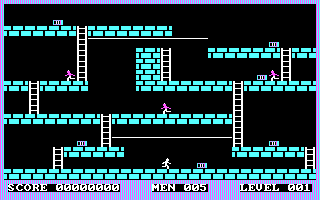
Snarf is an arcade-style maze action game developed and published by Everett Kaser for MS-DOS, with the first public release appearing in 1988. Designed as a shareware title for EGA systems, the game tasks the player with navigating a series of maze-like levels while collecting treasure, avoiding enemies called “Snarfs,” and managing a diminishing “tag count” that functions as a health mechanic. The game ultimately grew to include more than fifty levels and became notable for its combination of fast arcade gameplay and light strategic elements.
Gameplay is structured around collecting treasure—rings, crowns, and other valuables—to build level scores, while maintaining enough remaining tag points to survive.Contact with a Snarf reduces the player’s tag count, and reaching zero ends the game. First-aid stations appear intermittently (roughly every two to four levels) and fully restore the player’s tags, introducing a survival-based rhythm to progression. Keys, locks, and teleports add puzzle-like elements to navigation, while the requirement that each level must include at least one Snarf pit ensures consistent enemy pressure. Levels end when the player successfully reaches the far right side of the map.
The game offers a variety of features unusual for shareware titles of its era, including customizable controls, multiple difficulty-related shot modes, and adjustable game speed. A distinctive element is the scoring system, which multiplies a level’s accumulated treasure value by the remaining tag count at level completion, encouraging careful play and efficient treasure collection. Snarf also features a continuously running demo screen, high-score table, and in-game help system.
One of Snarf’s most significant features is its built-in level editor, accessible by pressing F1 during gameplay. The editor allows players to modify existing levels or create entirely new ones, supporting custom walls, teleports, treasures, pits, color palettes, and even pixel-level editing of wall tiles. Levels are stored as external files and can be rearranged or replaced by renaming them. This degree of user extensibility contributed to the game’s longevity and community interest.
Snarf was distributed under the shareware model, allowing users to freely copy and share the unregistered version while encouraging registration for continued use. As a member of the Association of Shareware Professionals, the developer supported users by phone, mail, and CompuServe, while offering updates and optional accessory materials. Over time, Snarf has retained a modest but dedicated following, recognized for its colorful EGA presentation, responsive controls, and blend of arcade action with light puzzle elements.
Text: RetroGames.cz, licensed under CC BY-SA 3.0
Controls
This is a PC game: it uses the keyboard the way it did under MS-DOS, and the mouse where the game supports it. Click the game screen first so it gets your key presses.
Many DOS games start with a menu or ask a question first — read the screen and answer with the keyboard. Arrow keys, Enter, Space, Ctrl and Alt are the usual game keys.
Live chat
Connecting…
Controls
This is a PC game: it uses the keyboard the way it did under MS-DOS, and the mouse where the game supports it. Click the game screen first so it gets your key presses.
Many DOS games start with a menu or ask a question first — read the screen and answer with the keyboard. Arrow keys, Enter, Space, Ctrl and Alt are the usual game keys.
Comments