Wolfenstein 3D
2.1M plays 1992 #Action#Shooter
Wolfenstein 3D is a first-person shooter developed by id Software and published by Apogee Software for MS-DOS on May 5, 1992. It reimagined the premise of Muse Software's early stealth games Castle Wolfenstein and Beyond Castle Wolfenstein as a much faster action game viewed through the protagonist's eyes. The first episode, Escape from Castle Wolfenstein, was distributed as shareware and could be freely copied, while the remaining episodes were sold by mail order. This model spread the game extraordinarily widely and helped turn the young id Software into one of the most influential PC developers of the 1990s.
John Carmack's engine evolved from the technology used in Hovertank 3D and Catacomb 3-D. It uses ray casting to draw textured walls at high speed while enemies, weapons and decorations are represented by two-dimensional sprites. The levels are constructed on a flat rectangular grid: walls meet at right angles, floors and ceilings remain at fixed heights, and rooms cannot be placed above one another. These restrictions allowed contemporary PCs to produce unusually smooth, immediate movement and created a convincing illusion of a three-dimensional environment without calculating a complete polygonal world.
The player controls American agent William 'B.J.' Blazkowicz as he explores maze-like fortresses, opens doors, activates elevators and searches the walls for hidden passages. Guards react to sight and sound, while officers, attack dogs, SS troops and undead mutants differ in speed, resilience and firepower. The arsenal consists of a knife, pistol, machine gun and chaingun; all firearms draw from the same ammunition supply, making weapon changes simple and keeping the pace uninterrupted. Health packs and food restore injuries, and blood can provide a desperate final recovery when B.J.'s health is extremely low.
Every episode contains nine regular floors and one secret floor, with an episode boss waiting near the end. Treasure raises the score, extra lives can be found or earned through points, and concealed rooms contain ammunition, healing items and valuables. The statistics screen records completion time and the percentages of enemies killed, treasures collected and secrets discovered, rewarding both rapid escapes and exhaustive exploration. One famous secret stage recreates a maze from Pac-Man from a first-person perspective, complete with dangerous ghosts, while the DOS version allows progress to be saved at almost any moment.
The first three episodes form the main storyline. Escape from Castle Wolfenstein begins after B.J. is captured while investigating Operation Eisenfaust; armed with a knife and a pistol taken from a guard, he must break out and defeat prison commander Hans Grosse. Operation: Eisenfaust sends him to Castle Hollehammer, where Dr. Schabbs is creating an army of undead mutants. In Die, Führer, Die!, B.J. enters a bunker beneath the Reichstag and ultimately confronts Adolf Hitler, first in a mechanical battle suit and then carrying four chainguns.
The registered edition adds three more episodes collectively called The Nocturnal Missions, which take place before the original trilogy and concern a Nazi chemical-warfare programme known as Giftkrieg. A Dark Secret follows the hunt for weapons researcher Dr. Otto Giftmacher, Trail of the Madman centres on plans guarded by Gretel Grosse in Castle Erlangen, and Confrontation ends with General Fettgesicht in Castle Offenbach. Together, the six episodes provide sixty floors, including six hidden ones, even though the architecture, Nazi experiments and exaggerated villains are deliberately fantastical rather than historically authentic. The standalone follow-up Spear of Destiny, released later in 1992, used the same technology for another campaign.
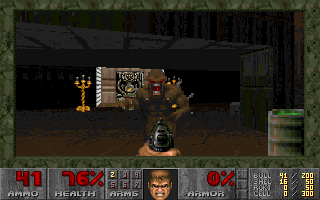
Wolfenstein 3D was not the first first-person action game, but its speed, clarity and enormous shareware circulation made the form accessible to a mass audience. Its violence, Nazi imagery, German speech and use of the Horst-Wessel-Lied also caused controversy and led to restrictions or altered releases in several territories. The game established many conventions later refined by Doom, including a weapon displayed at the bottom of the screen, rapid maze exploration, secret areas and escalating enemy encounters. Its technology soon became dated, but its direct design remains highly playable, and its influence on the emergence of the modern first-person shooter is difficult to overstate.
Text: RetroGames.cz, licensed under CC BY-SA 3.0
Controls
This is a PC game: it uses the keyboard the way it did under MS-DOS, and the mouse where the game supports it. Click the game screen first so it gets your key presses.
Many DOS games start with a menu or ask a question first — read the screen and answer with the keyboard. Arrow keys, Enter, Space, Ctrl and Alt are the usual game keys.
Comments