Galaga
1.3M plays 1994 #Shooter
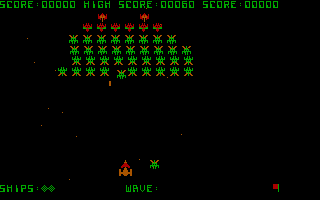
Galaga is a 1981 fixed shooter video game developed and published by Namco for arcades. It was released by Midway Manufacturing in North America. It is the sequel to 1979's Galaxian, and the second game in the Galaxian series. Controlling a starship, the player is tasked with destroying the Galaga forces in each stage while avoiding enemies and projectiles. "Boss Galaga" enemies can capture a player's ship via a tractor beam, which can be rescued by another ship to give the player a "dual fighter" with additional firepower.
Shigeru Yokoyama led development with a small team. Initial planning took about two months to finish. Originally developed for the Namco Galaxian arcade board, it was instead shifted to a new system as suggested by Namco's Research and Development division. Inspiration for the dual fighter mechanic was taken from a film that Yokoyama had seen prior to development, in which a ship was captured using a large circular beam. The project became immensely popular around the company, with Namco's president Masaya Nakamura even taking interest.
From Wikipedia's article Galaga, licensed under CC BY-SA 4.0
Controls
This is a PC game: it uses the keyboard the way it did under MS-DOS, and the mouse where the game supports it. Click the game screen first so it gets your key presses.
Many DOS games start with a menu or ask a question first — read the screen and answer with the keyboard. Arrow keys, Enter, Space, Ctrl and Alt are the usual game keys.
Live chat
Connecting…
Controls
This is a PC game: it uses the keyboard the way it did under MS-DOS, and the mouse where the game supports it. Click the game screen first so it gets your key presses.
Many DOS games start with a menu or ask a question first — read the screen and answer with the keyboard. Arrow keys, Enter, Space, Ctrl and Alt are the usual game keys.
3.5 Good job
Players 76 · 6,277 votes
No critic scores found for this game: this is the players' rating.
Review scorecard
- Graphics 3.5 out of 5 Overall fallback
- Sound 3.5 out of 5 Overall fallback
- Control 3.5 out of 5 Overall fallback
- Fun Factor 3.5 out of 5 Overall fallback
Overall fallback: Players 76 · 6,277 votes. The same 76/100 overall rating fills missing categories using the face scale; these are not separate category scores. Player rating; no critic scores available.
What the reviews talk about
Key wordsengagingfaithfuloriginalfast-pacedcolourfuleasy
What the critics said
In a 1998 retrospective review, AllGame said the strategy stood out amongst other games of its type, describing the gameplay as "perfectly balanced shooting action."
— AllGame
Reviewing the NES home version, GameSpy called Galaga a "must play for arcade freaks", praising the port's accurate representation of the arcade version in terms of its graphics, sound effects and gameplay.
— GameSpy· about another version
Famicom Tsūshin commended the Game Boy version's faithful conversion alongside its support for the Super Game Boy peripheral, while Electric Playground stated that it should " be near the top of your Game Boy's next purchase list".
— Famitsu, 1995· about another version
From the Reception section of Wikipedia's Galaga article, under CC BY-SA 4.0. The words are the critics'; their full reviews are on the publishers' pages.
Scores
- Giant Bomb true
- AllGame 5/5; 2.5/5; 4/5; 5/5 (other versions)
- Computer and Video Games Positive
- Eurogamer 2011 5/10 (other versions)
- Famitsu 7/10, 6/10, 5/10, 6/10 (other versions)
- GameSpot 2006 6.5/10 (other versions)
- GameSpy 8/10 (other versions)
- IGN 2007 7.5/10 (other versions)
- Joystick 80% (other versions)
- Nintendo Life 2014 7/10 (other versions)
From the review table of Wikipedia's article. The face takes, first that applies: the Metascore for this platform, GameRankings' average, our average of the critics (one number per publication, a panel averaged), one review alone, the players' rating. Critics and players are never mixed.
Comments