Doom II: Hell on Earth
998K plays 1994 #Action#Shooter
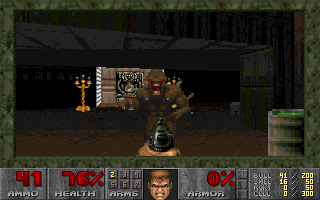
Doom II: Hell on Earth is a first-person shooter developed by id Software and released for MS-DOS on 10 October 1994. Unlike the original Doom, which initially appeared as shareware, the sequel was published by GT Interactive as a full commercial game sold through ordinary shops. It uses the same basic technology and visual style as its predecessor, concentrating on new maps, enemies and combat situations rather than a new engine. This apparent conservatism allowed id Software to deliver a much larger continuation only ten months after the first game.
The story begins immediately after the marine's return from Hell. He discovers that demons have invaded Earth and that the surviving population cannot escape while the only usable spaceport remains sealed by an infernal force field. After clearing a path for the evacuation ships, the marine traces the invasion to a portal in his own ruined city and enters Hell once more. His journey ends in a confrontation with the Icon of Sin, whose destruction closes the gateway and gives humanity a chance to rebuild the planet.
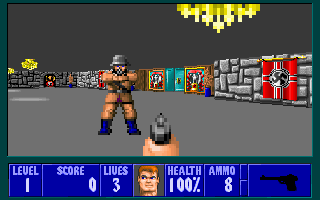
The essentials remain unchanged: the player explores maze-like areas, searches for coloured keys and switches, collects weapons and ammunition, and fights demons while looking for the exit. Doom II abandons the first game's separate episode structure in favour of one continuous sequence of 32 maps, including two secret stages inspired by Wolfenstein 3D. Equipment is carried from one level to the next, and the larger layouts contain more open spaces, interconnected routes, traps and encounters involving far greater numbers of monsters. Hidden rooms continue to reward careful exploration with health, armour, ammunition and early access to powerful weapons.
The only completely new weapon is the double-barrelled Super Shotgun, but its enormous close-range damage and forceful sound make it one of the game's defining additions. The bestiary is expanded much more substantially with creatures such as the Revenant, Mancubus, Arachnotron, Pain Elemental, Hell Knight, Arch-vile and Chaingunner. Bosses from Doom also return as ordinary opponents. Their different attacks and movement patterns create denser battles in which positioning, target priority and deliberately provoking monsters to fight one another are often more important than simple reflexes.
Doom II retains the fast movement, immediate controls and pseudo-three-dimensional environments of the original engine. Floors can exist at different heights, lifts and doors reshape the routes through a map, and lighting helps establish a convincing mixture of military bases, devastated cities and infernal structures. The player cannot jump or freely aim up and down; vertical targeting is handled automatically. Although the technology was no longer new in 1994, the more ambitious maps and larger enemy groups demanded stronger hardware and pushed the established engine considerably harder.
The DOS release supports cooperative play and competitive deathmatch over local networks or direct connections, continuing the social aspect that had helped make Doom a phenomenon. Its data structure also made the sequel an enduring foundation for user-created levels and modifications, and an enormous community gradually formed around the game. id Software later published Master Levels for Doom II, containing twenty commissioned levels and one secret map, while Final Doom supplied two further 32-level adventures. Modern source ports have kept the original maps playable on later computers and greatly expanded their technical possibilities.
Doom II was received very positively and won the Origins Award for the best fantasy or science-fiction computer game of 1994. Some critics considered its city maps less coherent than the tighter episodes of the original, but the expanded monster roster, Super Shotgun and capacity for large-scale encounters became fundamental to later Doom level design. The game was also a major commercial success and appeared on numerous other systems. More than three decades later, its mechanics and editable format continue to support new maps, total conversions and competitive play, making the MS-DOS release one of the most durable action games of its era.
Text: RetroGames.cz, licensed under CC BY-SA 3.0
Controls
This is a PC game: it uses the keyboard the way it did under MS-DOS, and the mouse where the game supports it. Click the game screen first so it gets your key presses.
Many DOS games start with a menu or ask a question first — read the screen and answer with the keyboard. Arrow keys, Enter, Space, Ctrl and Alt are the usual game keys.
Comments