Space Harrier
18K plays #Shooter
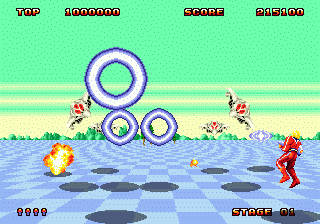
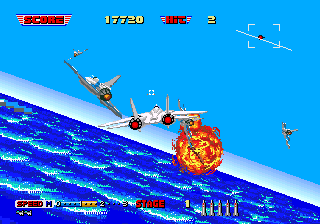
Space Harrier is a rail shooter developed by Sega and released in 1985 as an arcade video game. The player navigates surreal landscapes while defeating enemies as a jet-propelled human character. Designed by Yu Suzuki, it was conceived as a realistic military-themed combat flight simulation game, but technical and memory restrictions resulted in Suzuki redesigning it around a fantasy setting. The arcade game is controlled by an analog flight stick while the deluxe arcade cabinet is a cockpit-style linear actuator motion simulator cabinet that pitches and rolls during play, for which it is referred as a taikan (体感) or "body sensation" arcade game in Japan.
It was a commercial success in arcades, becoming one of Japan's top two highest-grossing upright/cockpit arcade games of 1986 (along with Sega's Hang-On). Critically praised for its innovative graphics, gameplay and motion cabinet, Space Harrier is often ranked among Suzuki's best works. It has made several crossover appearances in other Sega titles, and inspired a number of clones and imitators, while Capcom and PlatinumGames director Hideki Kamiya cited it as an inspiration for him entering the video game industry.
From Wikipedia's article Space Harrier, licensed under CC BY-SA 4.0
Keyboard controls
| 32X | Player 1 | Player 2 |
|---|---|---|
| D-pad | ↑↓←→ | IKJL |
| A | Z | N |
| B | X | M |
| C | C | , |
| X | A | Y |
| Y | S | U |
| Z | D | O |
| Mode | Shift | B |
| Start | Enter | Space |
Hotkeys
- 1 Quick save state
- 2 Quick load state
- 3 Change save slot
X, Y and Z are for six-button games such as Street Fighter II.
Gamepads are detected when you press a button. Remap any key from the emulator’s Controls menu (gear icon).
Live chat
Connecting…
Keyboard controls
| 32X | Player 1 | Player 2 |
|---|---|---|
| D-pad | ↑↓←→ | IKJL |
| A | Z | N |
| B | X | M |
| C | C | , |
| X | A | Y |
| Y | S | U |
| Z | D | O |
| Mode | Shift | B |
| Start | Enter | Space |
Hotkeys
- 1 Quick save state
- 2 Quick load state
- 3 Change save slot
X, Y and Z are for six-button games such as Street Fighter II.
Gamepads are detected when you press a button. Remap any key from the emulator’s Controls menu (gear icon).
4.0 Great job!
Players 80 · 22 votes
No critic scores found for this game: this is the players' rating.
Review scorecard
- Graphics 4.0 out of 5 Overall fallback
- Sound 4.0 out of 5 Overall fallback
- Control 4.0 out of 5 Overall fallback
- Fun Factor 4.0 out of 5 Overall fallback
Overall fallback: Players 80 · 22 votes. The same 80/100 overall rating fills missing categories using the face scale; these are not separate category scores. Player rating; no critic scores available.
What the reviews talk about
Key wordseasyoriginalweirddifficultfaithfulcomplex
What the critics said
Computer and Video Games called the port "an entirely unpretentious computer game full of weird and wacky nasties".
— Computer and Video Games
That same year, IGN's Levi Buchanan opined: "Even today, Space Harrier is a sight to behold, a hellzapoppin' explosion of light, color, and imagination".
— IGN, 2008 (Levi Buchanan)
Kotaku named the Space Harrier tribute stage from Bayonetta in their 2013 selection of "the trippiest video game levels".
— Kotaku, 2013
Ed Semrad of The Milwaukee Journal gave the Master System port a 9/10 rating, and Computer Gaming World deemed it "the best arcade shoot-'em-up of the year... as exciting a game as this reviewer has ever played".
— Computer Gaming World, 1987· about another version
Paul Mellerick of Sega Force wrote that the Game Gear version was "amazingly close to the original... the scrolling's the speediest and smoothest ever seen".
— Sega Force, 1992 (Paul Mellerick)· about another version
Lucas Thomas of IGN rated the 2008 Wii port a 4.5 score out of 10, citing its "poor visuals and poor control" and "dulled" color palette.
— IGN, 2008 (Lucas Thomas)· about another version
Jeff Gerstmann of Giant Bomb, in his review of Sonic's Ultimate Genesis Collection, criticized the Space Harrier emulation's "numerous audio issues that make it sound completely different from the way the original game sounds".
— Giant Bomb, 2009 (Jeff Gerstmann)· about another version
From the Reception section of Wikipedia's Space Harrier article, under CC BY-SA 4.0. The words are the critics'; their full reviews are on the publishers' pages.
Scores
- AllGame 2014 4.5/5 (32X) ; 2.5/5 (PC) ; 4.5/5 (SMS) ; 3/5 (T16) ; 3/5 (Wii)
- Next Generation 1995 3/5 (32X) (other versions)
- Crash 1986 77% (ZX) (other versions)
- Computer and Video Games 1986 Positive (arcade) ; 82% (Amiga) ; 35/40 (CPC) ; 78% (SMS) ; 89% (T16) ; 34/40 (ZX)
- GamePro 4/5 (32X) (other versions)
- GameSpy 2008 9/10 (SMS) (other versions)
- IGN 2008 4.5/10 (Wii) (other versions)
- Micromanía 1987 8/10 (SMS) (other versions)
- Sinclair User 1986 Positive (arcade) ; 5/5 (ZX) (other versions)
- Tilt 1987 16/20 (SMS) (other versions)
- Your Sinclair 1987 9/10 (ZX) (other versions)
- Zzap!64 1989 85% (Amiga) (other versions)
- Computer Gamer 1986 Positive (arcade)
- Gamest 1986 19/24 (arcade) (other versions)
From the review table of Wikipedia's article. The face takes, first that applies: the Metascore for this platform, GameRankings' average, our average of the critics (one number per publication, a panel averaged), one review alone, the players' rating. Critics and players are never mixed.

Comments