Quake
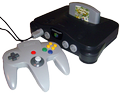
207K plays 1996 #Action#Shooter
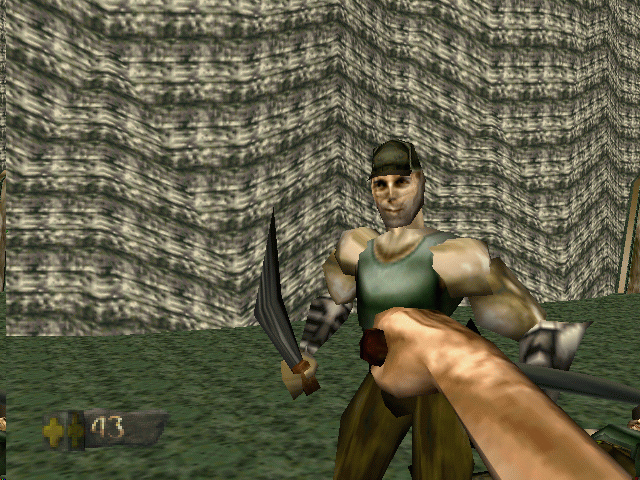
Quake is a 1996 first-person shooter video game developed by id Software and published by GT Interactive. It is the first game in the Quake series. Originally released for MS-DOS, it was ported to Linux, Windows, Mac OS, and the Sega Saturn in 1996–1997 and to the Nintendo 64 in 1998. The plot centers on teleportation experiments, dubbed Slipgates, that have resulted in an unforeseen invasion of Earth by a hostile force code-named Quake, which commands a vast army of monsters. The player, a soldier, travels through the Slipgates to find and destroy the source of the invasion. The game alternates between futuristic military bases and medieval, gothic environments, with both science fiction and fantasy weaponry and enemies, such as possessed soldiers, ogres, and armor-clad knights. It draws heavily on gothic fiction and the works of H. P. Lovecraft, and was originally inspired by a Dungeons & Dragons campaign among id Software staff.
The successor to id's Doom series, Quake built upon the technology and gameplay of its predecessor. Unlike the Doom engine before it, the Quake engine offered full real-time 3D rendering and early support for 3D acceleration through OpenGL. After Doom helped establish deathmatches, Quake added various multiplayer options, and online multiplayer became increasingly common with the QuakeWorld update and services such as QuakeSpy. The music was composed by Nine Inch Nails, whose frontman Trent Reznor also voices the player character.
From Wikipedia's article Quake (video game)
Keyboard controls
| N64 | Player 1 |
|---|---|
| Stick | ↑↓←→ |
| A | X |
| B | C |
| Z | Z |
| L | A |
| R | S |
| C buttons | IKJL |
| D-pad | TGFH |
| Start | Enter |
Hotkeys
- 1 Quick save state
- 2 Quick load state
- 3 Change save slot
A gamepad with an analog stick plays much better than the keyboard.
Gamepads are detected when you press a button. Remap any key from the emulator’s Controls menu (gear icon).
Live chat
Connecting…
Keyboard controls
| N64 | Player 1 |
|---|---|
| Stick | ↑↓←→ |
| A | X |
| B | C |
| Z | Z |
| L | A |
| R | S |
| C buttons | IKJL |
| D-pad | TGFH |
| Start | Enter |
Hotkeys
- 1 Quick save state
- 2 Quick load state
- 3 Change save slot
A gamepad with an analog stick plays much better than the keyboard.
Gamepads are detected when you press a button. Remap any key from the emulator’s Controls menu (gear icon).
3.0 Good job
Metascore 74
Review scorecard
- Graphics 3.0 out of 5 Overall fallback
- Sound 3.0 out of 5 Overall fallback
- Control 3.0 out of 5 Overall fallback
- Fun Factor 3.0 out of 5 Overall fallback
Overall fallback: Metascore 74. Overall source The same 74/100 overall rating fills missing categories using the face scale; these are not separate category scores.
What the reviews talk about
Key wordssmoothoriginalviolentpreciseshallowexcellent
What the critics said
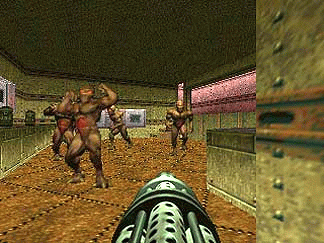
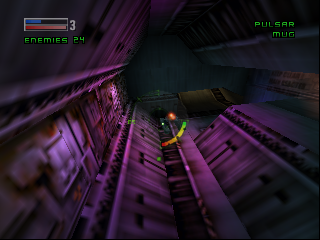
IGN judged the visuals superior to those of the unaccelerated PC version despite the simplified environments, concluding that "The Nintendo 64 version of Quake is exceptionally well done, but it's still the same game."
— IGN, 1998
Electronic Gaming Monthly's Kraig Kujawa wrote that "Quake is not a great one-player game – it gained its notoriety on the Net as a multiplayer", and co-reviewer Sushi-X concluded, "Without multiplayer, I'd pass."
— Electronic Gaming Monthly, 1998 (Kraig Kujawa)
Most critics did find it technically impressive, particularly the added light sources, but Next Generation replied that porting Quake to a console was "nothing more than an excuse for bragging rights".
— Next Generation, 1998
Next Generation rated the Macintosh version four stars out of five, saying that although replay value was limited, "there's no doubt that Quake and its engine are something powerful and addictive."
— Next Generation, 1997 · about another version
Most reviews also found the controls much worse than the PC original, particularly aiming without a mouse or second thumb stick, and GamePro noted graphics so pixelated and blurry that newcomers could not discern what they were looking at, concluding that the port "certainly doesn't live up to its PC heritage".
— GamePro, 1998 · about another version
Sega Saturn Magazine's Rich Leadbetter, who gave the port a higher 92%, acknowledged it as a dancing bear, arguing that "the machine has no right to be doing this!"
— Sega Saturn Magazine, 1997 (Rich Leadbetter) · about another version
From the Reception section of Wikipedia's Quake (video game) article.
Scores
- 100 Computer Games Magazine1996 5/5
- 100 Computer and Video Games1996 5/5
- 90 GameRevolution2004 9/10
- 90 PC Gamer (UK)1996 90/100
- 80 Electronic Gaming Monthly1998 6.5/10 (SAT) ; 8.0/10 (N64)
- 80 IGN1998 8/10 (N64)
- 69 GameSpot1998 9.3/10 (PC) ; 6.4/10 (SAT) ; 6.9/10 (N64)
- 60 Next Generation1996 5/5 (PC) ; 4/5 (MAC) ; 3/5 (SAT) ; 3/5 (N64) ; 3/5 (ARC)
- 92 GameFan1997 275/300 (SAT) · other versions
- 70 AllGame 3.5/5 (SAT) · other versions
From the review table in Wikipedia's Quake (video game) article.
Comments