Pyramid
12K plays 1990 #Puzzle
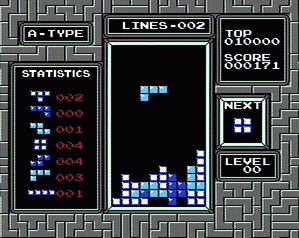
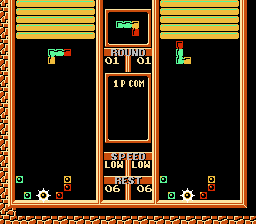
Pyramid is a real-time puzzle video game developed and published by Taiwanese company Sachen in 1990 for the Nintendo Entertainment System (NES). Originally appearing as a minigame in Dong Dong Nao 2, Pyramid was later released as a standalone title. The game draws heavy inspiration from Tetris, but introduces its own gameplay twists through the use of triangular and trapezoidal pieces rather than traditional square and rectangular shapes. An improved version, Pyramid II, was later released with additional features and a revised storyline.
The gameplay of Pyramid centers around fitting falling stones of various angular shapes into complete horizontal lines at the bottom of the screen. When a player successfully completes a line, it is cleared, and points are awarded. Unlike Tetris, players can only clear up to two rows at a time; however, doing so grants them a bomb, which can be used to clear a small cross-shaped section of blocks on the field. Bombs offer strategic opportunities but can also create awkward gaps, making the playing field more difficult to manage if used carelessly. As with other puzzle games of its kind, the game ends if the stack of pieces reaches the top of the screen.
The game’s narrative differs depending on the release region. In the original Taiwanese version, players take on the role of a scholar exploring the mysteries of the pyramids. In the AVE and HES localized versions, the player is cast as Dr. Otto Spetalbonky, an explorer who has discovered ancient games once played in the tomb of Queen Lera-Di'-Ty, also known as the Queen of Fun. Pyramid II expands on this, involving an evil presence awakening in the pyramids in the year 20XX, prompting divine intervention by a 'Marvelous Soldier' to prevent its return.
Two distinct versions of Pyramid exist. The standard version, released in most markets, provides additional bombs as gameplay bonuses. Meanwhile, a special release by Hacker International includes adult-themed artwork featuring Cleopatra, illustrated by Yoshimasa Watanabe, shown in cutscenes as an incentive for gameplay progression, along with the extra bombs.
While Pyramid introduces a unique twist on the classic falling block puzzle formula, its non-standard piece shapes, such as triangles and trapezoids, make gameplay less intuitive than Tetris. The game has been described as competent but lacking in polish, with minimal frills and basic audiovisual presentation. Despite these criticisms, it remains a notable entry in Sachen’s library and was also ported to the Watara Supervision along with several other early titles from the company.
Text: RetroGames.cz, licensed under CC BY-SA 3.0
Keyboard controls
| NES | Player 1 | Player 2 |
|---|---|---|
| D-pad | ↑↓←→ | IKJL |
| B | Z | N |
| A | X | M |
| Select | Shift | B |
| Start | Enter | Space |
Hotkeys
- 1 Quick save state
- 2 Quick load state
- 3 Change save slot
Gamepads are detected when you press a button. Remap any key from the emulator’s Controls menu (gear icon).
Live chat
Connecting…
Keyboard controls
| NES | Player 1 | Player 2 |
|---|---|---|
| D-pad | ↑↓←→ | IKJL |
| B | Z | N |
| A | X | M |
| Select | Shift | B |
| Start | Enter | Space |
Hotkeys
- 1 Quick save state
- 2 Quick load state
- 3 Change save slot
Gamepads are detected when you press a button. Remap any key from the emulator’s Controls menu (gear icon).
Comments