Pac-Land
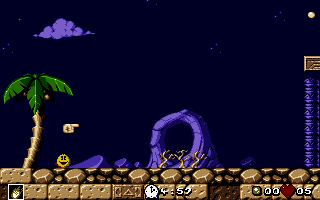
Pac-Land is a 1984 platform game developed and published by Namco for arcades. It was released in North America by Bally Midway, and in Europe by Atari Games. Controlling Pac-Man, the player must make it to the end of each stage to return a lost fairy back to its home in Fairyland. Pac-Man will need to avoid obstacles, such as falling logs and water-spewing fire hydrants, alongside his enemies, the Ghost Gang. Eating large flashing Power Pellets will cause the ghosts to turn blue, allowing Pac-Man to eat them for points.
Pac-Land was conceptualized by Namco Research and Development 1 programmer Yoshihiro Kishimoto, who was tasked with creating an arcade game based on the American Pac-Man cartoon television series by Hanna-Barbera. The backgrounds were made to be vibrant and colorful, and the characters to be detailed and move smoothly to match the show's animation style. The control scheme was inspired by Konami's Track & Field (1983), using buttons instead of a traditional joystick to make it stand out among other games at the time. A new Namco Pac-Land arcade system was created to make it easier to develop the game and was used for several later Namco games, including Baraduke (1985) and Metro-Cross (1985).
From Wikipedia's article Pac-Land, licensed under CC BY-SA 4.0
Keyboard controls
| Lynx | Player 1 |
|---|---|
| D-pad | ↑↓←→ |
| B | Z |
| A | X |
| Option 1 | A |
| Option 2 | S |
| Pause | Enter |
Hotkeys
- 1 Quick save state
- 2 Quick load state
- 3 Change save slot
Gamepads are detected when you press a button. Remap any key from the emulator’s Controls menu (gear icon).
Live chat
Connecting…
Keyboard controls
| Lynx | Player 1 |
|---|---|
| D-pad | ↑↓←→ |
| B | Z |
| A | X |
| Option 1 | A |
| Option 2 | S |
| Pause | Enter |
Hotkeys
- 1 Quick save state
- 2 Quick load state
- 3 Change save slot
Gamepads are detected when you press a button. Remap any key from the emulator’s Controls menu (gear icon).
2.5 Could be better
Players 65 · 473 votes
No critic scores found for this game: this is the players' rating.
Review scorecard
- Graphics 2.5 out of 5 Overall fallback
- Sound 2.5 out of 5 Overall fallback
- Control 2.5 out of 5 Overall fallback
- Fun Factor 2.5 out of 5 Overall fallback
Overall fallback: Players 65 · 473 votes. The same 65/100 overall rating fills missing categories using the face scale; these are not separate category scores. Player rating; no critic scores available.
What the reviews talk about
Key wordscolourfulblandoriginaleasy
What the critics said
He called it an "interesting game" where Pac-Man is an "animated character that moves along a horizontally scrolling landscape" while praising the "very colouful" graphics and stating it is "easy to play once you've got the hang of it."
— Computer Gamer, 1985
AllGame was particularly critical of the TurboGrafx-16 version, lambasting its poor graphics, bland stage layouts and lack of challenge, jokingly saying it was only recommended to collectors interested in "the most morbidly poor games in existence".
— AllGame· about another version
From the Reception section of Wikipedia's Pac-Land article, under CC BY-SA 4.0. The words are the critics'; their full reviews are on the publishers' pages.
Scores
- Computer and Video Games 1989 90% (PCE) ; 92% (PCE) ; 7/10 (Lynx) (other versions)
- Electronic Gaming Monthly 1991 7/10, 6/10, 6/10, 5/10 (Lynx) (other versions)
- Famitsu 7/10, 7/10, 8/10, 8/10 (PCE) (other versions)
- IGN 1999 7/10 (Lynx) ; 6.5/10 (TG16) (other versions)
- Raze 74% (Lynx) (other versions)
From the review table of Wikipedia's article. The face takes, first that applies: the Metascore for this platform, GameRankings' average, our average of the critics (one number per publication, a panel averaged), one review alone, the players' rating. Critics and players are never mixed.
Comments