King Kong
80K plays 1982 #Action#Platform
King Kong is a platform video game developed by Karl T. Olinger and published by Tigervision for the Atari 2600 in 1982. It is based on the licensed King Kong character and was the company’s first cartridge release. The game has been noted as an early attempt to translate the iconic giant ape franchise into a home console title, and it was also produced in a handheld version licensed to Tandy by Tiger Electronic Toys in the same year.
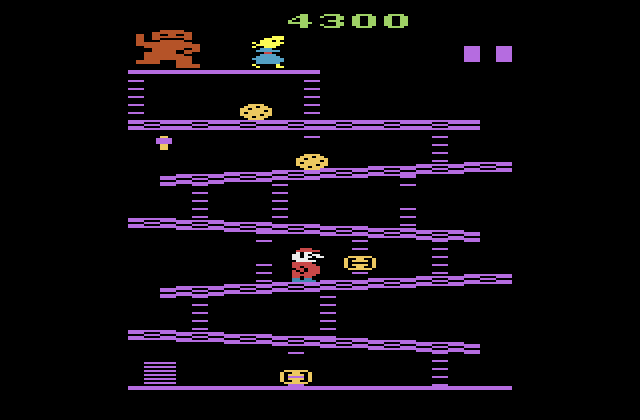
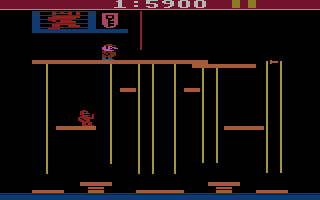
The gameplay of King Kong closely mirrors the structure of the original arcade Donkey Kong game. Players control a character named Jack who must climb ladders, navigate platforms, and avoid autonomous bombs (and occasionally special “magic bombs”) thrown by King Kong in order to reach the top of the single stage and rescue a captured woman. Magic bombs are worth more points and can propel the player to higher platforms when successfully jumped over, and a bonus timer counts down during play — if it reaches zero the player loses a life.
King Kong supports one or two players alternating turns and offers gameplay options such as slow or fast bombs and the inclusion or exclusion of magic bombs, allowing players to tweak the challenge. The mechanics are simple, reflecting both the constraints of the Atari 2600 hardware and the game’s focus on straightforward platforming action.
Critical reception at the time was mixed to negative. Some contemporary reviewers found elements of King Kong enjoyable for a first cartridge effort, noting competent graphics for the platform, while others described it as a crude imitation of Donkey Kong’s first scenario, replacing barrels and fire creatures with bombs and other obstacles. In one early review, Arcade Express rated the game 4 out of 10 and described it as “a poor rendition of the giant ape,” and commentary from Electronic Games similarly critiqued the substitution of generic hazards in place of more iconic elements.
In retrospect, King Kong is often viewed as an example of early licensed platformers on the Atari 2600 that struggled to capture the spirit and depth of their arcade inspirations. Its simplistic level design — with a repeating single stage that increases only in speed — and basic audiovisual presentation have led many retro critics and players to regard it as less engaging than both the original Donkey Kong and other contemporary platform titles, despite its historical significance as the first Kong video game adaptation.
Text: RetroGames.cz, licensed under CC BY-SA 3.0
Keyboard controls
| Atari 2600 | Player 1 | Player 2 |
|---|---|---|
| D-pad | ↑↓←→ | IKJL |
| Fire | Z | N |
| Game Select | Shift | |
| Game Reset | Enter |
Hotkeys
- 1 Quick save state
- 2 Quick load state
- 3 Change save slot
Most games start with Game Reset. Paddle games (Breakout, Kaboom!…) need a gamepad stick.
Gamepads are detected when you press a button. Remap any key from the emulator’s Controls menu (gear icon).
Live chat
Connecting…
Keyboard controls
| Atari 2600 | Player 1 | Player 2 |
|---|---|---|
| D-pad | ↑↓←→ | IKJL |
| Fire | Z | N |
| Game Select | Shift | |
| Game Reset | Enter |
Hotkeys
- 1 Quick save state
- 2 Quick load state
- 3 Change save slot
Most games start with Game Reset. Paddle games (Breakout, Kaboom!…) need a gamepad stick.
Gamepads are detected when you press a button. Remap any key from the emulator’s Controls menu (gear icon).

Comments