Double Dragon
507K plays #Action
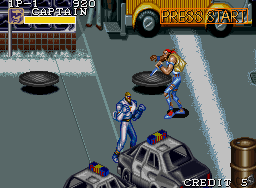
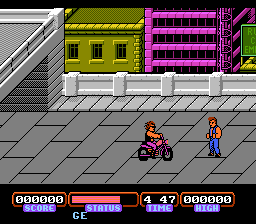
Double Dragon is a 1987 beat 'em up video game developed by Technōs Japan and published by Taito for arcades. The game's development was led by Yoshihisa Kishimoto, and it is a spiritual and technological successor to Technos' earlier beat 'em up, Nekketsu Kōha Kunio-kun (1986), released outside of Japan by Taito as Renegade; Kishimoto originally envisioned it as a direct sequel and part of the Kunio-kun series, before making it a new game with a different cast and setting.
Double Dragon introduced several additions to the Kunio-kun belt scroll beat 'em up formula, such as a continuous side-scrolling world adding a sense of progression, two-player cooperative gameplay, the ability to arm oneself with an enemy's weapon after disarming them, and the use of cutscenes to give it a cinematic look and feel. The game's title is a reference to the two-player gameplay and Bruce Lee's martial arts film Enter the Dragon (1973), which was a major inspiration behind Kunio-kun and Double Dragon, while the game's art style and setting were influenced by the Mad Max films and the Fist of the North Star manga and anime series.
From Wikipedia's article Double Dragon (video game), licensed under CC BY-SA 4.0
Keyboard controls
| Lynx | Player 1 |
|---|---|
| D-pad | ↑↓←→ |
| B | Z |
| A | X |
| Option 1 | A |
| Option 2 | S |
| Pause | Enter |
Hotkeys
- 1 Quick save state
- 2 Quick load state
- 3 Change save slot
Gamepads are detected when you press a button. Remap any key from the emulator’s Controls menu (gear icon).
Live chat
Connecting…
Keyboard controls
| Lynx | Player 1 |
|---|---|
| D-pad | ↑↓←→ |
| B | Z |
| A | X |
| Option 1 | A |
| Option 2 | S |
| Pause | Enter |
Hotkeys
- 1 Quick save state
- 2 Quick load state
- 3 Change save slot
Gamepads are detected when you press a button. Remap any key from the emulator’s Controls menu (gear icon).
3.0 Good job
Players 69 · 1,523 votes
No critic scores found for this game: this is the players' rating.
Review scorecard
- Graphics 3.0 out of 5 Overall fallback
- Sound 3.0 out of 5 Overall fallback
- Control 3.0 out of 5 Overall fallback
- Fun Factor 3.0 out of 5 Overall fallback
Overall fallback: Players 69 · 1,523 votes. The same 69/100 overall rating fills missing categories using the face scale; these are not separate category scores. Player rating; no critic scores available.
What the reviews talk about
Key wordsaddictivevariedoriginaldetailedeasyfun
What the critics said
In the July 1987 issue of Computer and Video Games, Clare Edgeley described the "sordid street fights" as "great fun when you've got the guts" and "if you manage to get hang of the controls".
— Computer and Video Games
She concluded that "all the ingredients are there for a really addictive, martial arts style kick 'em to bits".
— Computer and Video Games, 1987
In the October 1987 issue of Crash, the reviewer Tony described it as "the best game of its kind around" and "thoroughly addictive".
— Crash
He noted the game's popularity, stating that it took him "about half an hour to get near it in my local arcade" and "a brief glance around West End arcades confirmed" that "Double Dragon is set to be a massive coin-op hit".
— Dragon· about another version
Computer Gaming World noted the limitations of a joystick caused the IBM and C64 ports to use fewer moves than the arcade, the C64 port, in particular, being "a pale shadow of the original".
— Computer Gaming World, 1989· about another version
From the Reception section of Wikipedia's Double Dragon (video game) article, under CC BY-SA 4.0. The words are the critics'; their full reviews are on the publishers' pages.
Scores
- Giant Bomb true
- ACE 863; 298; 275
- Computer and Video Games 1987 Positive; 85%; 83%; 83%; 54%; 54%; 54%; 56% (other versions)
- Crash Positive; 81% (other versions)
- Electronic Gaming Monthly 1990 7/10, 7/10, 7/10, 7/10 (other versions)
- The Games Machine (UK) 81% (other versions)
- Joystick 71%; 75%; 91% (other versions)
- Sinclair User 51% (other versions)
- Your Sinclair 1988 Positive; 8/10 (other versions)
From the review table of Wikipedia's article. The face takes, first that applies: the Metascore for this platform, GameRankings' average, our average of the critics (one number per publication, a panel averaged), one review alone, the players' rating. Critics and players are never mixed.
Comments