Bomberman
4.6M plays 1985 #Action
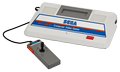
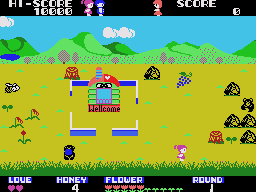
Bomberman Special for the SG-1000 is an unlicensed Taiwanese conversion of Hudson Soft's 1986 MSX game rather than an official Sega or Hudson release. Published in Taiwan by DahJee under Chinese titles, it brought a version of the classic maze action game to Sega-compatible hardware through the region's distinctive market for converted software. The precise release date is not reliably documented, but the program is derived from the MSX adaptation of the 1985 Famicom Bomberman. Its unusual origin makes it one of the most obscure early appearances of the character on a home console.
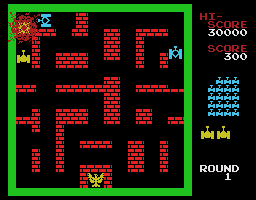
The game follows the structure established by the Famicom version. Bomberman must escape from an underground complex by completing fifty stages, eliminating every enemy and uncovering the exit hidden beneath a destructible block. Bombs explode after a delay and send flames in four directions, destroying soft walls and any creature caught in their path. Since Bomberman is equally vulnerable to his own weapons, successful play depends on leaving enough room to retreat before each explosion.
One power-up is concealed in every stage and may increase the number of available bombs, extend their flames or improve movement speed. Later abilities allow remote detonation, movement through selected obstacles or protection from explosions, greatly expanding the tactics available to an experienced player. Passwords make it possible to resume the long sequence of levels while retaining a selection of acquired equipment. New enemies and denser mazes gradually make timing and route planning more demanding.
Bomberman Special closely reproduces the MSX edition, which itself transferred the Famicom design back to the computer platform on which the series began. Compared with the NES game, movement and animation are slower, the colours are more limited and the presentation lacks the same smooth scrolling and responsiveness. The core relationship between bombs, breakable walls, enemies and narrow escape routes nevertheless remains recognisable. It is a single-player game and therefore predates the competitive multiplayer battles that later became Bomberman's defining attraction. At least two Taiwanese cartridge variants are known: the 48 KB DahJee release requires the company's RAM expansion adapter with an SG-1000 or SC-3000, while another documented cartridge operates without that additional hardware. These variants illustrate how Taiwanese manufacturers extended the console's library by adapting MSX programs built around closely related technology.
As a conversion, Bomberman Special is clearly inferior to the faster and more polished NES version, and its repetitive solo campaign offers none of the social appeal associated with later games in the series. Its importance instead lies in its rarity, unusual technical background and place within the poorly documented history of unlicensed Asian console software. The game preserves the essential risk-and-reward rhythm of placing a bomb and racing for safety, even when the hardware struggles to present it smoothly. For collectors and historians, it is therefore more interesting as an unexpected Taiwanese SG-1000 artefact than as the ideal way to play early Bomberman.
Text: RetroGames.cz, licensed under CC BY-SA 3.0
Keyboard controls
| SG-1000 | Player 1 | Player 2 |
|---|---|---|
| D-pad | ↑↓←→ | IKJL |
| Button 1 | Z | N |
| Button 2 | X | M |
| Pause | Enter |
Hotkeys
- 1 Quick save state
- 2 Quick load state
- 3 Change save slot
Gamepads are detected when you press a button. Remap any key from the emulator’s Controls menu (gear icon).
Comments