Bomberman II
366K plays 1991 #Action
Bomberman II, known as Dynablaster in Europe and Australia, is a maze-based action and puzzle game developed and published by Hudson Soft for the Nintendo Entertainment System. It was released in Japan and Europe in 1991, followed by a North American release in 1993. A sequel to the original NES Bomberman, the game retains the series' distinctive combination of maze navigation, timed explosives and destructible environments while expanding the concept with a more developed story and multiplayer modes.
The story begins when White Bomberman witnesses Black Bomberman committing a bank robbery. Black Bomberman knocks him down and leaves the stolen money behind, causing White Bomberman to be falsely accused of the crime and sent to prison. The player's task is therefore to escape captivity and ultimately bring the real culprit to justice. Progress is made by navigating enclosed maze-like stages, destroying obstacles and enemies with bombs and locating the exit hidden beneath one of the destructible blocks.
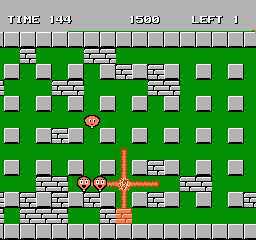
The basic gameplay closely follows the established Bomberman formula. Bombs explode after a short delay, sending flames horizontally and vertically across the maze and requiring careful positioning to avoid being caught in the blast. Destroyed blocks can reveal power-ups that improve Bomberman's abilities, including increasing the number of bombs that can be placed simultaneously and extending their blast radius. The single-player campaign comprises multiple areas divided into individual stages, while a password system records the player's progress and acquired bomb capabilities, allowing a later game to be resumed without starting from the beginning.
A particularly important feature of Bomberman II is its competitive multiplayer. Vs Mode allows two players to fight one another by placing bombs around an arena, while Battle Mode expands the competition to three players with the use of the NES Four Score accessory. The objective is simple—trap opponents within the explosions while avoiding both enemy bombs and one's own—but the combination of destructible barriers, limited space and gradually increasing firepower creates a strong tactical element. This emphasis on direct multiplayer competition would become one of the defining characteristics of the Bomberman series in subsequent generations.
Contemporary reviews were generally favorable, although opinions varied between publications. Collected period reviews give the game an average score of approximately 72%, while Nintendo Power rated its graphics at 2.9/5, play control at 3.5/5, challenge at 3.3/5 and theme/fun at 3.4/5. While Bomberman II remains mechanically close to its predecessor, its additional multiplayer options and refined version of the established bomb-based gameplay make it a notable entry in the early history of the series.
Text: RetroGames.cz, licensed under CC BY-SA 3.0
Keyboard controls
| NES | Player 1 | Player 2 |
|---|---|---|
| D-pad | ↑↓←→ | IKJL |
| B | Z | N |
| A | X | M |
| Select | Shift | B |
| Start | Enter | Space |
Hotkeys
- 1 Quick save state
- 2 Quick load state
- 3 Change save slot
Gamepads are detected when you press a button. Remap any key from the emulator’s Controls menu (gear icon).
Comments