Tetris
532K plays 1988 #Puzzle
Tetris is a puzzle game developed and published by Bullet-Proof Software for the Nintendo Family Computer. Released exclusively in Japan on December 22, 1988, it was the first home-console adaptation of Alexey Pajitnov’s original game. It should not be confused with Nintendo’s internationally released NES version or the different edition published in North America by Tengen. The BPS release was commercially successful, selling approximately two million copies in Japan, and played an important part in Henk Rogers’s subsequent efforts to secure the official console and handheld rights to Tetris.
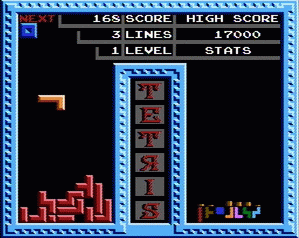
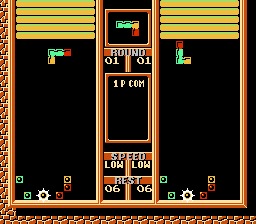
The basic objective follows the familiar Tetris formula. Seven differently shaped tetrominoes descend into a playfield measuring ten squares across and twenty squares high. The player can move and rotate each piece while attempting to create complete horizontal lines, which disappear and leave more space for additional blocks. Clearing several lines with a single piece awards more points, while allowing the pile to reach the top costs one of the player’s three lives.
Rather than offering an endless mode, the Famicom version is organized as a sequence of stages. The player must clear 25 lines to complete each stage, after which the playfield is emptied and the next challenge begins. There are six rounds containing ten stages apiece. Higher stages increase the falling speed, while later rounds begin with progressively more obstructing blocks at the bottom of the playfield. After the final stage has been completed, the game displays an ending sequence before allowing play to continue.
The most unusual and frequently criticized feature is the control scheme inherited from BPS’s Japanese computer versions. Pressing down on the directional pad rotates the current piece, while the A button immediately drops and locks it into position. There is no conventional soft-drop control, and a misplaced press of the A button cannot be corrected. Although no universal console standard for Tetris controls existed in 1988, this arrangement feels particularly awkward when compared with Nintendo’s later NES and Game Boy editions, in which the directional pad controls downward movement and the buttons rotate the pieces.
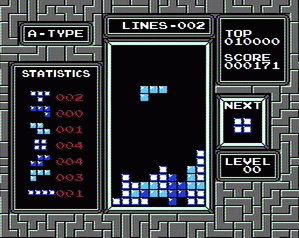
The presentation is simple but functional, displaying the score, current stage, remaining lines and a preview of the next tetromino beside the playfield. Its music includes Technotris, an original composition that later returned in other BPS Tetris games. The absence of multiplayer and the restrictive controls make this edition less accessible than the Nintendo and Tengen versions released the following year, but its stage-based structure provides a clear sense of progression. More importantly, the game remains historically significant as the first console version of Tetris and as an early milestone in the puzzle game’s transformation into an international phenomenon.
Text: RetroGames.cz, licensed under CC BY-SA 3.0
Keyboard controls
| NES | Player 1 | Player 2 |
|---|---|---|
| D-pad | ↑↓←→ | IKJL |
| B | Z | N |
| A | X | M |
| Select | Shift | B |
| Start | Enter | Space |
Hotkeys
- 1 Quick save state
- 2 Quick load state
- 3 Change save slot
Gamepads are detected when you press a button. Remap any key from the emulator’s Controls menu (gear icon).
Comments