Tetris

532K plays 1988 #Puzzle
Tetris is a puzzle game developed by Nintendo R&D1 and published by Nintendo for the Game Boy in 1989. Based on Alexey Pajitnov’s original design, it was created after Henk Rogers and his company Bullet-Proof Software secured the handheld rights from the Soviet organization Elorg and sublicensed them to Nintendo. The game was directed by Satoru Okada, produced by Gunpei Yokoi and programmed by Masao Yamamoto. It was released in Japan on June 14, 1989, followed by North America in July and Europe in 1990. Bundling Tetris with the Game Boy in North America and Europe helped both the game and Nintendo’s new handheld reach an exceptionally broad audience.
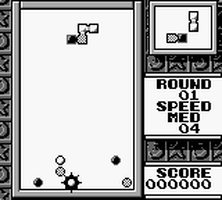
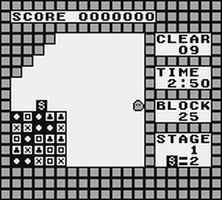
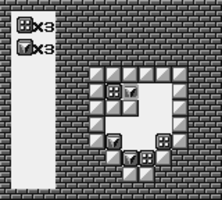
The basic objective is to arrange falling tetrominoes into complete horizontal lines. Finished lines disappear and award points, while the pieces above them descend into the resulting space. The falling speed increases as the player advances through the levels, and the game ends when the accumulated blocks prevent a new piece from entering the playfield. The controls are simple and responsive: the directional pad moves pieces sideways or accelerates their descent, while the A and B buttons rotate them in opposite directions.
The single-player game offers two principal modes. Type A is an endless challenge in which the player attempts to survive and achieve the highest possible score as the speed increases after every ten cleared lines. Type B requires the removal of 25 lines and allows both the starting speed and the height of the obstructing blocks at the bottom of the playfield to be selected. Successful Type B games are rewarded with animated scenes whose content depends on the chosen difficulty, including musicians, dancing figures and several types of launching spacecraft.
A particularly important feature is the competitive two-player mode, which requires two Game Boys, two cartridges and a Game Link Cable. Both participants play simultaneously, attempting either to clear 30 lines or force the opponent’s stack to reach the top. Clearing two, three or four lines at once sends incomplete rows to the bottom of the opposing playfield. This direct interaction transformed Tetris from a solitary score challenge into a competitive game and demonstrated the potential of the Game Boy’s link-cable hardware.
The monochrome graphics are necessarily simple but exceptionally clear on the original handheld screen. Hirokazu Tanaka’s soundtrack offers three selectable musical themes, including an arrangement of the Russian folk song Korobeiniki, which became closely associated with Tetris in popular culture. More than 35 million copies were sold worldwide, including those bundled with the console, making it the best-selling individual version of the game. Its portability, precise controls and influential multiplayer mode established Tetris as the Game Boy’s defining launch title and one of the most important puzzle games ever released.
Text: RetroGames.cz, licensed under CC BY-SA 3.0
Keyboard controls
| Game Boy | Player 1 |
|---|---|
| D-pad | ↑↓←→ |
| B | Z |
| A | X |
| Select | Shift |
| Start | Enter |
Hotkeys
- 1 Quick save state
- 2 Quick load state
- 3 Change save slot
Gamepads are detected when you press a button. Remap any key from the emulator’s Controls menu (gear icon).

Comments