Strider
45K plays 1989 #Platform
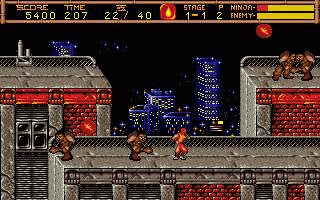
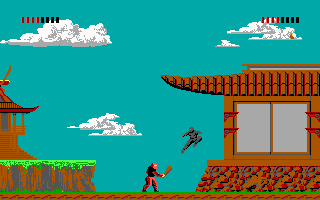
Strider, released in Japan as Strider Hiryū, is a 1989 hack and slash platform game developed and published by Capcom for arcades. Set in a dystopian future in which Earth is ruled by the tyrannical Grandmaster Meio, it follows the titular Strider named Hiryu as he attempts to end Meio's tyrannical reign for good. The game resulted from cooperation between Capcom and manga publisher Moto Kikaku. It marked the video game debut of Strider Hiryu, after the character was introduced in the 1988 manga Strider Hiryū.
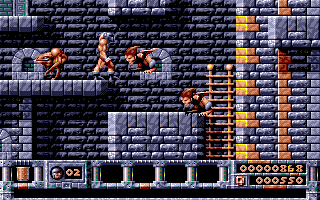
The game debuted on Capcom's CP System arcade board. Various home computer ports were developed by Tiertex and published by U.S. Gold in 1989. The NES version has a different plot than the original. Sega released Strider for its own Genesis console in 1990. Of all home versions, the Genesis adaptation is considered the most successful, winning the Game of the Year and Best Graphics in a Video Game awards from Electronic Gaming Monthly in 1990.
Strider's gameplay is cited as a major influence on the video game franchises Ninja Gaiden, Devil May Cry, and God of War. It became one of Capcom's early hits, praised for its innovative gameplay, diverse and unique music, and multilingual voice samples.
From Wikipedia's article Strider (1989 arcade game), licensed under CC BY-SA 4.0
Controls
This is a PC game: it uses the keyboard the way it did under MS-DOS, and the mouse where the game supports it. Click the game screen first so it gets your key presses.
Many DOS games start with a menu or ask a question first — read the screen and answer with the keyboard. Arrow keys, Enter, Space, Ctrl and Alt are the usual game keys.
Live chat
Connecting…
Controls
This is a PC game: it uses the keyboard the way it did under MS-DOS, and the mouse where the game supports it. Click the game screen first so it gets your key presses.
Many DOS games start with a menu or ask a question first — read the screen and answer with the keyboard. Arrow keys, Enter, Space, Ctrl and Alt are the usual game keys.
3.0 Good job
Players 72 · 64 votes
No critic scores found for this game: this is the players' rating.
Review scorecard
- Graphics 3.0 out of 5 Overall fallback
- Sound 3.0 out of 5 Overall fallback
- Control 3.0 out of 5 Overall fallback
- Fun Factor 3.0 out of 5 Overall fallback
Overall fallback: Players 72 · 64 votes. The same 72/100 overall rating fills missing categories using the face scale; these are not separate category scores. Player rating; no critic scores available.
What the reviews talk about
Key wordsdetailedgorgeousatmosphericstunningfaithfulsmooth
What the critics said
The Games Machine called it "THE platform and ladders game to be seen playing at the moment."
— The Games Machine, 1989
Commodore User praised the "high definition graphics, brilliant movements and good old-fashioned blasting action" along with a "bit of tongue-in-cheek political" content.
— Commodore User, 1989
Mark Caswell of Crash magazine referred to the game's graphics as detailed and incredible, the scrolling and action as smooth and called the gameplay "some of the most demanding gameplay ever invented".
— Crash, 2020 (Mark Caswell)
Upon release, GamePro called the Genesis port "a faithful translation of the arcade hit", and praised its "gorgeous graphics, non-stop arcade-style action, and... captivating and unusual sound track."
— GamePro, 1990· about another version
From the Reception section of Wikipedia's Strider (1989 arcade game) article, under CC BY-SA 4.0. The words are the critics'; their full reviews are on the publishers' pages.
Scores
- ACE 1989 919; 910; 910; 876 (CPC)
- AllGame 2014 4/5; 4.5/5; 3/5; 4/5 (other versions)
- Computer and Video Games 1989 95%; 92%; 88% (CPC) (other versions)
- Electronic Gaming Monthly 1990 9/10, 9/10, 9/10, 9/10 (other versions)
- Famitsu 2014 30/40; 20/40 (other versions)
- GamePro 22/25 (other versions)
- GameSpy 2008 9/10 (other versions)
- Joystick 96%; 80% (other versions)
- Nintendo Life 2012 9/10 (other versions)
- ST Format 1989 92% (other versions)
- The Games Machine (UK) 1989 Positive; 94%; 93%; 93% (CPC) (other versions)
- Your Sinclair 89%; 90% (other versions)
- Zero 1989 81%; 84% (other versions)
From the review table of Wikipedia's article. The face takes, first that applies: the Metascore for this platform, GameRankings' average, our average of the critics (one number per publication, a panel averaged), one review alone, the players' rating. Critics and players are never mixed.


Comments