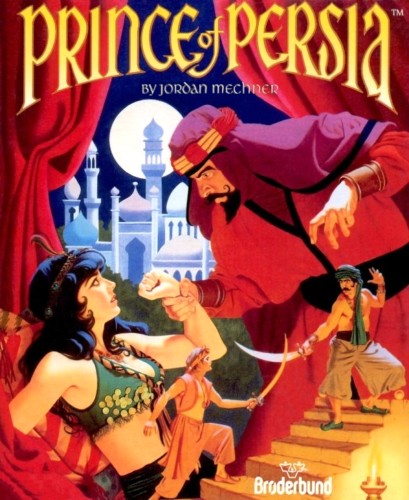
Prince of Persia
3.7M plays 1989 #Action#Platform
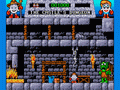
Prince of Persia is a 1989 cinematic platform game developed and published by Broderbund for the Apple II. It was designed and implemented by Jordan Mechner. Taking place in medieval Persia, players control an unnamed protagonist who must venture through a series of dungeons to defeat the evil Grand Vizier Jaffar and save an imprisoned princess.
Much like Karateka, Mechner's first video game, Prince of Persia used rotoscoping for its fluid and realistic animation. For this process, Mechner used as reference for the characters' movements videos of his brother doing acrobatic stunts in white clothes and swashbuckler films such as The Adventures of Robin Hood.
The game was critically acclaimed and, while not an immediate commercial success, sold many copies as it was ported to a wide range of platforms after the original Apple II release. It is believed to have been the first cinematic platformer and inspired many games in this subgenre, such as Another World. Its success launched the Prince of Persia franchise, consisting of two sequels, Prince of Persia 2: The Shadow and the Flame (1993) and Prince of Persia 3D (1999), and two reboots: Prince of Persia: The Sands of Time (2003), which was followed by three sequels of its own, and Prince of Persia (2008).
From Wikipedia's article Prince of Persia (1989 video game)
Controls
This is a PC game: it uses the keyboard the way it did under MS-DOS, and the mouse where the game supports it. Click the game screen first so it gets your key presses.
Many DOS games start with a menu or ask a question first — read the screen and answer with the keyboard. Arrow keys, Enter, Space, Ctrl and Alt are the usual game keys.
From the manual, pages 8–9
Live chat
Connecting…
Controls
This is a PC game: it uses the keyboard the way it did under MS-DOS, and the mouse where the game supports it. Click the game screen first so it gets your key presses.
Many DOS games start with a menu or ask a question first — read the screen and answer with the keyboard. Arrow keys, Enter, Space, Ctrl and Alt are the usual game keys.
From the manual, pages 8–9
5.0 Outstanding!
Génération 4 90% · 1 review
Review scorecard
- Graphics 5.0 out of 5 Overall fallback
- Sound 5.0 out of 5 Overall fallback
- Control 5.0 out of 5 Overall fallback
- Fun Factor 5.0 out of 5 Overall fallback
Overall fallback: Génération 4 90% · 1 review. Overall source The same 90/100 overall rating fills missing categories using the face scale; these are not separate category scores.
What the reviews talk about
Key wordsfluidexcellentchallengingdifficult
What the critics said
Charles Ardai of Computer Gaming World wrote that the game package's claim that it "breaks new ground with animation so uncannily human it must be seen to be believed" was true.
— Computer Gaming World (Charles Ardai)
In 1996, Computer Gaming World named Prince of Persia the 84th best game ever, with the editors calling it "an acrobatic platformer with amazingly fluid action".
— Computer Gaming World, 1996
Electronic Gaming Monthly (EGM) likewise assessed the Genesis version as "an excellent conversion of the classic action game", and added that the game's challenging strategy and technique give it high longevity.
— Electronic Gaming Monthly, 1994 · about another version
From the Reception section of Wikipedia's Prince of Persia (1989 video game) article.
Scores
- 90 Génération 42015 90%
- 100 Dragon 5/5 · other versions
- 92 Mean Machines1992 91%; 93% · other versions
- 80 Electronic Gaming Monthly 32/40 · other versions
From the review table in Wikipedia's Prince of Persia (1989 video game) article.
Comments