SPOC: The Chess Master
19K plays 1983 #Puzzle
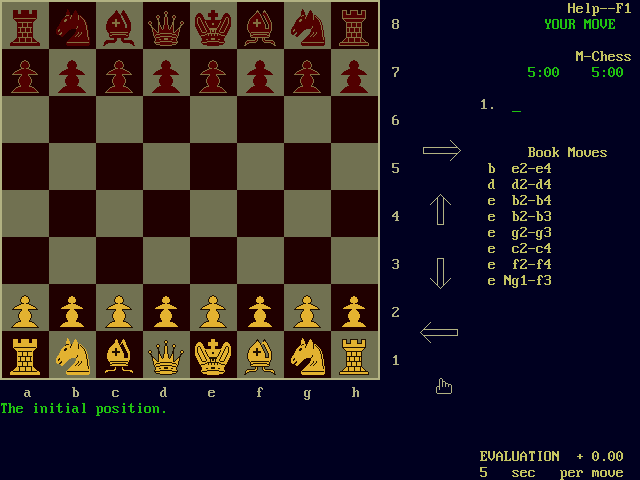
SPOC: The Chess Master is a computer chess program created by Jacques Middlecoff for the IBM PC and released commercially in 1983 by Cypress Software. Written entirely in 8086 assembly language, it was designed specifically for the limited processing power of early personal computers. Its title is an abbreviation of “Selective Pruning Optimization Chess”, referring to the method used by the program to reduce the number of positions examined during its calculations.
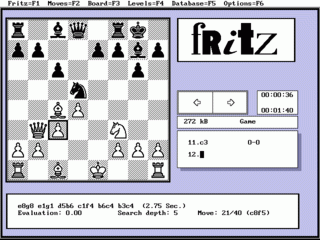
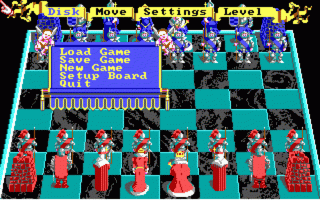
The game presents the chessboard from a conventional overhead perspective using the IBM PC’s CGA graphics. Its visual presentation is functional rather than elaborate, placing the emphasis on the computer opponent and the management of a complete chess match. As with other chess programs of the period, players enter moves through a relatively simple interface and then wait while the computer calculates its response.
The selective search suggested by the program’s name attempts to concentrate processing time on promising variations instead of examining every possible continuation to the same depth. This was particularly important on early IBM PC hardware, where both speed and available memory were severely restricted. At the 1985 ACM North American Computer Chess Championship, SPOC reportedly searched approximately 300 positions per second—a modest figure by later standards, but representative of contemporary personal-computer chess software.
The improved SPOC 2.0 added several useful features. Players could retract moves, construct positions manually and promote pawns to any permitted piece rather than being restricted to a queen. Position setup made the program more useful for studying specific situations or experimenting with chess problems, while the ability to take back moves made casual play and analysis considerably more convenient.
Contemporary reception was not especially enthusiastic. In a 1983 issue of PC Magazine, programmer and chess player Dave Whitehouse reviewed SPOC alongside Chess Partner and advised readers to wait for stronger alternatives. Nevertheless, the program later competed in the 1985 ACM championship, where it defeated Awit, drew with Ostrich and lost to Phoenix and CHAOS. Although SPOC never became one of the best-known computer chess programs, its assembly-language implementation and participation in a major computer chess tournament make it an interesting example of chess programming during the early IBM PC era.
Text: RetroGames.cz, licensed under CC BY-SA 3.0
Controls
This is a PC game: it uses the keyboard the way it did under MS-DOS, and the mouse where the game supports it. Click the game screen first so it gets your key presses.
Many DOS games start with a menu or ask a question first — read the screen and answer with the keyboard. Arrow keys, Enter, Space, Ctrl and Alt are the usual game keys.
Live chat
Connecting…
Controls
This is a PC game: it uses the keyboard the way it did under MS-DOS, and the mouse where the game supports it. Click the game screen first so it gets your key presses.
Many DOS games start with a menu or ask a question first — read the screen and answer with the keyboard. Arrow keys, Enter, Space, Ctrl and Alt are the usual game keys.
Comments