Colossus Chess X
1.1K plays 1988 #Puzzle
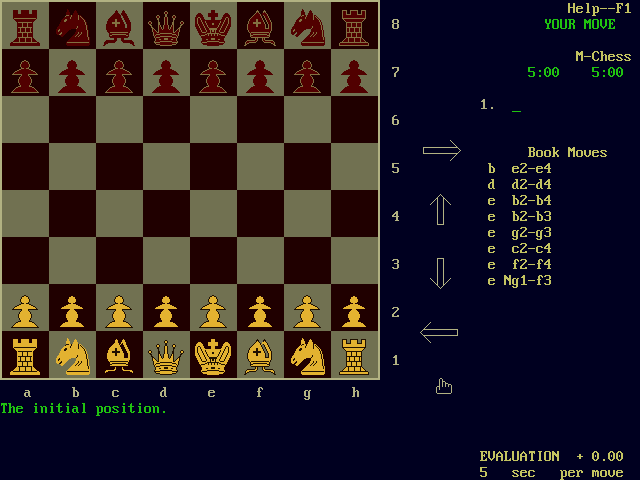
Colossus Chess X is a chess simulation developed by British programmer Martin Bryant and published by CDS Software. It is an enhanced 16-bit version of the Colossus Chess program, which had previously appeared on numerous 8-bit home computers. The first edition of Colossus Chess X was released for the Atari ST in 1988, followed by versions for the Commodore Amiga in 1989 and IBM PC compatibles in 1990.
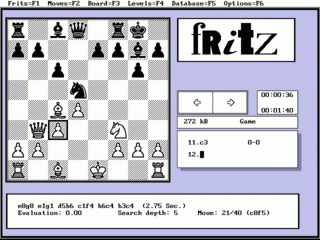
The program allows one player to compete against the computer, two human players to face each other, or the computer to play both sides as a demonstration. A wide range of playing strengths and time controls is available, from quick moves to longer tournament-style games. Players can take back moves, change sides, request hints, set up custom positions and save unfinished games for later continuation. The computer’s calculations can also be displayed, providing an indication of the moves and variations it is considering.
Unlike many early chess programs, Colossus Chess X implements the complete rules of the game, including castling, en passant captures, pawn promotion, draws by repetition and the fifty-move rule. It is also capable of performing basic mating procedures, including the difficult checkmate with bishop and knight. Its opening book contains approximately 11,000 positions and can be modified by the user, while a learning function allows the program to adjust its future play on the basis of earlier games.
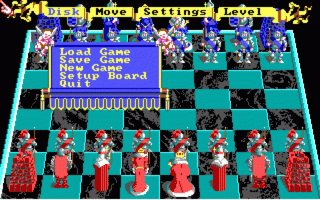
The board can be displayed in either two-dimensional or three-dimensional form, with four different sets of chess pieces available. The graphical interface was created with assistance from Gary Thomlinson and Carl Cropley and represented a considerable visual improvement over the earlier 8-bit editions. Nevertheless, presentation remains secondary to the chess engine, and the program is aimed primarily at players interested in a serious opponent rather than the elaborate animation offered by contemporary alternatives such as Battle Chess.
Colossus Chess X was generally well received for its combination of playing strength, extensive configuration options and clear presentation. The Games Machine awarded the Amiga version 86%, while comparisons with programs such as The Chessmaster 2000 and Chess Player 2150 produced varying results depending on the hardware and time controls used. Although later chess engines greatly surpassed its abilities, it remains a sophisticated example of late-1980s home-computer chess and an important entry in Martin Bryant’s long-running Colossus series.
Text: RetroGames.cz, licensed under CC BY-SA 3.0
Controls
This is a PC game: it uses the keyboard the way it did under MS-DOS, and the mouse where the game supports it. Click the game screen first so it gets your key presses.
Many DOS games start with a menu or ask a question first — read the screen and answer with the keyboard. Arrow keys, Enter, Space, Ctrl and Alt are the usual game keys.
Live chat
Connecting…
Controls
This is a PC game: it uses the keyboard the way it did under MS-DOS, and the mouse where the game supports it. Click the game screen first so it gets your key presses.
Many DOS games start with a menu or ask a question first — read the screen and answer with the keyboard. Arrow keys, Enter, Space, Ctrl and Alt are the usual game keys.
Comments