Sargon 4
15K plays 1988 #Puzzle
Sargon 4 is a chess program created by Dan and Kathe Spracklen and published by Spinnaker Software. It first appeared for the Macintosh in 1988, followed by an MS-DOS version in 1989. The game continued the influential Sargon series, whose origins date back to 1978, and served as a direct successor to Sargon III. The DOS edition introduced colour graphics and supported several display standards, including CGA, EGA, VGA, MCGA and Tandy/PCjr graphics.
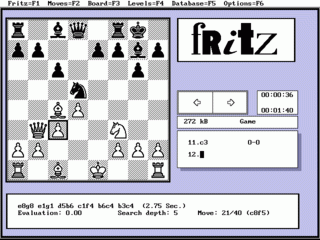
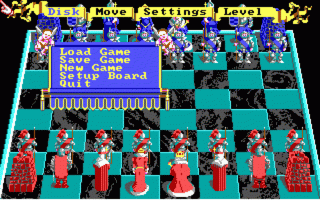
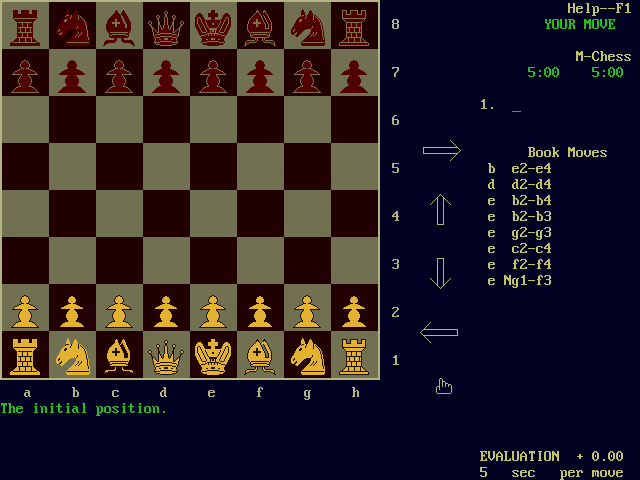
The central feature is a conventional chess match against the computer, although two human players can also compete using the same machine. Moves may be entered with either the keyboard or mouse, and the board can be displayed in both two-dimensional and three-dimensional forms. The program records the moves of the current game and allows players to observe information about Sargon’s search and evaluation, although displaying the search window reduces the amount of processing time available to the chess engine.
Beyond ordinary matches, Sargon 4 includes a substantial collection of instructional material. Its library contains 107 famous games played between 1851 and 1980, which can be replayed move by move. The player may interrupt one of these historical games and take control of either side, making the collection useful for examining alternative continuations. The program also provides a selection of chess problems that can be loaded and solved, giving it some value as a training tool as well as a computer opponent.
Graphically, the DOS version is a clear improvement over the earlier IBM PC edition of Sargon III. Its coloured boards and selectable viewing angles make the position easier to follow, while the mouse-driven interface reduces the need to remember keyboard commands. Nevertheless, the presentation remains functional rather than elaborate, and the three-dimensional pieces can occasionally be less readable than the simpler overhead display. An unusual connection with its predecessor can be seen on the DOS title screen, which uses artwork previously associated with releases of Sargon III.
Contemporary reception recognized Sargon 4 as a capable and demanding chess opponent, but reviews also noted that it faced increasingly strong competition. In a 1989 comparison, Computer Gaming World considered The Fidelity Chessmaster 2100 superior in its range of features, while still describing Sargon 4 as an outstanding playing partner. The result is a solid computer-chess package whose historical games, analysis facilities and playing strength remain its principal attractions, even though its interface and instructional options were less comprehensive than those of its most prominent rival.
Text: RetroGames.cz, licensed under CC BY-SA 3.0
Controls
This is a PC game: it uses the keyboard the way it did under MS-DOS, and the mouse where the game supports it. Click the game screen first so it gets your key presses.
Many DOS games start with a menu or ask a question first — read the screen and answer with the keyboard. Arrow keys, Enter, Space, Ctrl and Alt are the usual game keys.
Live chat
Connecting…
Controls
This is a PC game: it uses the keyboard the way it did under MS-DOS, and the mouse where the game supports it. Click the game screen first so it gets your key presses.
Many DOS games start with a menu or ask a question first — read the screen and answer with the keyboard. Arrow keys, Enter, Space, Ctrl and Alt are the usual game keys.
Comments