Road Rash

1.1M plays 1991 #Racing
Road Rash is a motorcycle racing and vehicular combat game developed and published by Electronic Arts, first released for the Sega Genesis in 1991. It sends the player into illegal races on public roads, where speed matters as much as the ability to knock rival riders from their motorcycles. The title refers to the severe friction burns suffered when an unprotected motorcyclist slides across asphalt. Its unusual mixture of racing, physical combat and financial consequences distinguished it from conventional motorcycle games and established the foundation of a long-running series.
The competition takes place across five Californian locations: Sierra Nevada, Pacific Coast, Redwood Forest, Palm Desert and Grass Valley. Each area returns over five increasingly difficult levels, with longer roads, faster opponents and more aggressive behaviour. The player must finish fourth or better on every course to advance, and ultimately complete all five races at the highest level. Although the structure repeats familiar roads, their rising speed and length steadily increase the pressure.
Viewed from behind the motorcycle, the action resembles Sega's Hang-On, but Road Rash adds pronounced climbs, descents and bends that affect visibility and handling. Cresting a hill at high speed can send the motorcycle into the air and leave almost no time to avoid what lies beyond it. Cars travel in both directions, while junctions, signs, trees, poles, animals and other roadside hazards can turn a small mistake into a spectacular crash. The traffic and changing scenery also recall the open-road spectacle of OutRun, although the roads here are considerably more hostile.
Combat is the feature that gives Road Rash its identity. When another rider comes alongside, the player can punch, backhand or kick, while some opponents carry clubs that can be stolen with a correctly timed attack. Successful blows reduce a rider's stamina; emptying the meter throws the victim from the motorcycle and can remove a dangerous rival from the immediate contest. Fighting is always risky, because looking for an opening can distract from the road, and every weapon or collision can be used against the player as easily as against an opponent.
Race results are tied to an economy that makes failure more serious than merely losing a position. Prize money can be saved toward eight progressively faster motorcycles, while crashes damage the current machine and may produce a repair bill. Motorcycle police patrol the courses, fight like other riders and can arrest the player after a fall; fines also rise as the competition advances. If the player cannot afford repairs or a police penalty, the career ends, so purchasing a faster bike must be balanced against keeping enough money in reserve.
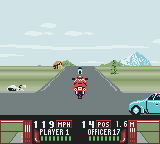
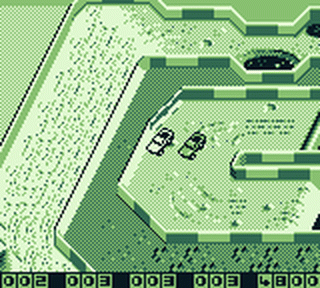
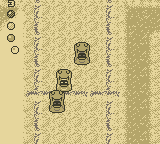
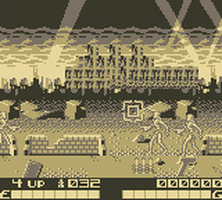
The Game Boy conversion was published by Ocean in 1996 and translates the game to a monochrome 160 × 144 display. The scenery, animation and number of visible details are greatly reduced, but the sloping roads, traffic, combat, five locations and career economy survive in recognisable form. Its road engine is an ambitious technical achievement for the handheld, even though the limited screen space can make hazards difficult to read. The original cartridge also relies on an LCD-controller behaviour absent from the Game Boy Color, causing it to freeze after the course selection on that later hardware; it should therefore be played on an original Game Boy or compatible emulator.
Text: RetroGames.cz, licensed under CC BY-SA 3.0
Keyboard controls
| Game Boy | Player 1 |
|---|---|
| D-pad | ↑↓←→ |
| B | Z |
| A | X |
| Select | Shift |
| Start | Enter |
Hotkeys
- 1 Quick save state
- 2 Quick load state
- 3 Change save slot
Gamepads are detected when you press a button. Remap any key from the emulator’s Controls menu (gear icon).
Comments