Lotus Turbo Challenge 2

25K plays 1991 #Racing
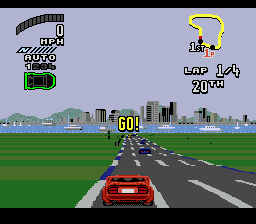
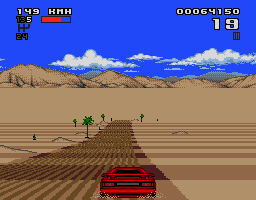
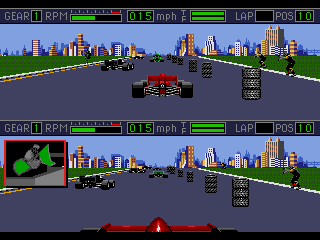
Lotus Turbo Challenge 2 is a sequel to Lotus Esprit Turbo Challenge and it is again a behind-the-car viewed racing game. The racing takes place in eight distinct circuits, with new surface and weather effects such as desert and snow. Later in the game, the player must race through two-way motorways with oncoming traffic (incorporating civilian cars and trucks), and face tougher levels aided by speed and time boost pick-ups.
The second Lotus game shifted focus to arcade-oriented gameplay. Being the first of the series released for a game console (for the Sega Mega Drive under the title Lotus Turbo Challenge), the fuel limit and difficulty levels were dropped, and the lap-based levels were replaced with course-based time trials (not unlike arcade games such as Out Run), with the player required to complete each course within a specified time to qualify for the next one. In addition to the Esprit Turbo SE, Lotus Turbo Challenge 2 also featured the Lotus Elan SE, hence 'Esprit' being dropped from the title. There was no choice of car however; the player runs with the Elan SE on odd levels, and with the Esprit on even levels.
Lotus 2's single-player mode uses all of the game screen instead of half, and opponent cars appear in a variety of colors (opponent cars in the original game were all white). The music is absent from racing altogether; the player instead hears the car's engine sound. Barry Leitch's intro music for Lotus 2 is often found on playlists of retro computer music webradio stations; it contains a subliminal message in the form of a sampled voice at around the 12-second mark (played through the left channel only) which says 'you will not copy this game'. The sample is played very quietly during the first few bars, and can be easily accessed in any MOD tracker program. The hi-hat and voice sample at the very beginning of the main theme is taken from Yello's Oh Yeah, a song that became famous as the theme for another sports car (a Ferrari 250 GT California) in the movie Ferris Bueller's Day Off.
Lotus 2 uses a password system to access different races - once the player qualifies for a particular race, the password is revealed. Additionally, a rendition of Shaun Southern's early creation Kwazy Kwaks, originally published for the VIC-20 in 1984, is accessed by using the password 'DUX'.
There is a touch of humour on level six (the motorway level) of the Amiga version: if the player manages to successfully drive under the trailer of one of the lorries that cross the road, the in-game announcer shouts 'Yeehaa!' This sound was used as a taunt on the Genesis port. The Amiga and Atari ST versions are able to use the serial port and connect to another computer (the players could link 2 Amiga, 2 Atari ST or an Amiga and an Atari ST) running Lotus 2, thus making it possible for three or four players to play at the same time, or two players to play in fullscreen mode. This feature does not exists in other versions, nor in the two other episodes.
Text: Wikipedia via RetroGames.cz, licensed under CC BY-SA 3.0
Keyboard controls
| Genesis | Player 1 | Player 2 |
|---|---|---|
| D-pad | ↑↓←→ | IKJL |
| A | Z | N |
| B | X | M |
| C | C | , |
| X | A | Y |
| Y | S | U |
| Z | D | O |
| Mode | Shift | B |
| Start | Enter | Space |
Hotkeys
- 1 Quick save state
- 2 Quick load state
- 3 Change save slot
X, Y and Z are for six-button games such as Street Fighter II.
Gamepads are detected when you press a button. Remap any key from the emulator’s Controls menu (gear icon).
Comments