RexChess
24K plays 1989 #Puzzle
RexChess is a commercial chess program developed by American programmers Don Dailey and Larry Kaufman for IBM PC-compatible computers running MS-DOS. Created around 1990 as the commercial successor to their earlier program Rex, it combines a chess engine written in highly efficient 8086 assembly language with a graphical interface programmed in Turbo Pascal. Kaufman, himself a strong chess player, contributed much of the program’s chess knowledge, while Dailey was principally responsible for its programming.
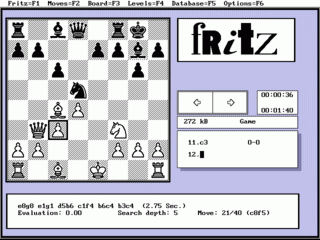
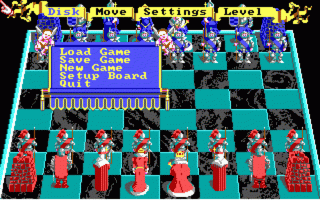
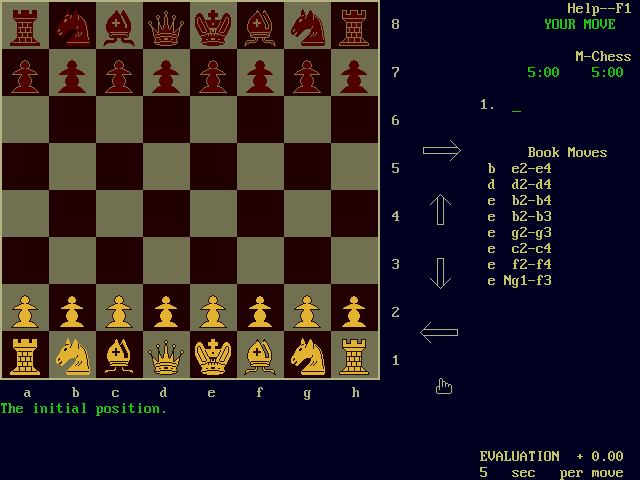
The game presents chess on a conventional two-dimensional board and allows the user to play complete matches against the computer. Its visual presentation is functional rather than decorative, reflecting the priorities of serious chess software of the period. Unlike more elaborate products such as Chessmaster, RexChess placed relatively little emphasis on animated pieces or audiovisual presentation; its main attraction was the playing strength of the underlying engine.
A particularly important feature of the program was its selective search system. Rather than examining every possible continuation to the same depth, the engine concentrated its computing resources on moves considered especially promising. The underlying ideas were developed by Dailey and Kaufman in cooperation with chess programmer Dave Kittinger, who employed related techniques in Novag’s Super Expert B and Super Forte B chess computers. This approach allowed Rex and subsequently RexChess to play competitive chess despite the limited processing power of contemporary personal computers.
An unfinished version of Rex participated in the 1989 World Computer Chess Championship in Edmonton, where it scored two points from five games. Dailey then spent approximately two months completing the engine and adding the features required for its commercial release. RexChess later competed against human players at several important man-versus-machine events. At the 1991 Aegon tournament it scored 3½ points from six games, defeating writer and chess player Tim Krabbé, drawing with grandmaster Jeroen Piket and losing to former world championship challenger David Bronstein. It also appeared at the 1991 Harvard Cup and the 1992 Aegon tournament.
Although RexChess is less widely remembered than commercial rivals such as Chessmaster or Battle Chess, its tournament appearances demonstrate that it was considerably more than a simple home chess game. Its efficient assembly-language engine and carefully tuned selective search made it a serious competitive program for its time. It also represents an important early chapter in the careers of Dailey and Kaufman, whose collaboration continued with Socrates and who were later both associated with the development of the powerful chess engine Komodo.
Text: RetroGames.cz, licensed under CC BY-SA 3.0
Controls
This is a PC game: it uses the keyboard the way it did under MS-DOS, and the mouse where the game supports it. Click the game screen first so it gets your key presses.
Many DOS games start with a menu or ask a question first — read the screen and answer with the keyboard. Arrow keys, Enter, Space, Ctrl and Alt are the usual game keys.
Live chat
Connecting…
Controls
This is a PC game: it uses the keyboard the way it did under MS-DOS, and the mouse where the game supports it. Click the game screen first so it gets your key presses.
Many DOS games start with a menu or ask a question first — read the screen and answer with the keyboard. Arrow keys, Enter, Space, Ctrl and Alt are the usual game keys.
Comments