Soko-Ban
120K plays 1988 #Puzzle
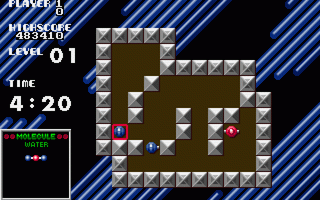
Sokoban is a type of transport puzzle, in which the player pushes boxes or crates around in a warehouse, trying to get them to storage locations. The puzzle is usually implemented as a video game. Sokoban was created in 1981 by Hiroyuki Imabayashi, and published in 1982 by Thinking Rabbit, a software house based in Takarazuka, Japan.
The game is played on a board of squares, where each square is a floor or a wall. Some floor squares contain boxes, and some floor squares are marked as storage locations. The player is confined to the board, and may move horizontally or vertically onto empty squares (never through walls or boxes). The player can also move into a box, which pushes it into the square beyond. Boxes may not be pushed into other boxes or walls, and they cannot be pulled. The puzzle is solved when all boxes are at storage locations.
In 1988, Sokoban was published in US by Spectrum HoloByte for the Commodore 64, DOS and Apple II as Soko-Ban. A version for the BBC Micro called Robol was published by a third party in 1993. The game was a hit in Japan, and had sold over 400,000 units in that country by the time Spectrum HoloByte imported it to the United States. This version of the game includes 50 levels.
A 1988 review in Computer Gaming World praised the game for being 'pure and simple, very playable and mentally challenging', citing its addictive qualities. It was also reviewed in 1988 in Dragon #132 by Hartley, Patricia, and Kirk Lesser in 'The Role of Computers' column. The reviewers gave the game 4½ out of 5 stars. Brian Wierda for Compute! said 'Soko-Ban may not be suited to the gung-ho action-adventure gamer, but if you're a puzzle solver, it's one of the best challenges you can find.' Paul Statt for InCider said 'once I got the tricks down – not just strategic tricks, but tactics such as using the arrow keys instead of the joystick – Soko-Ban became, if not easy, mindless. It simulates this type of work well – unfortunately, that's pretty weak praise for a game.'
Text: Wikipedia via RetroGames.cz, licensed under CC BY-SA 3.0
Controls
This is a PC game: it uses the keyboard the way it did under MS-DOS, and the mouse where the game supports it. Click the game screen first so it gets your key presses.
Many DOS games start with a menu or ask a question first — read the screen and answer with the keyboard. Arrow keys, Enter, Space, Ctrl and Alt are the usual game keys.
Live chat
Connecting…
Controls
This is a PC game: it uses the keyboard the way it did under MS-DOS, and the mouse where the game supports it. Click the game screen first so it gets your key presses.
Many DOS games start with a menu or ask a question first — read the screen and answer with the keyboard. Arrow keys, Enter, Space, Ctrl and Alt are the usual game keys.
Comments