Prince of Persia
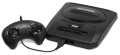
3.6M plays 1989 #Action#Platform
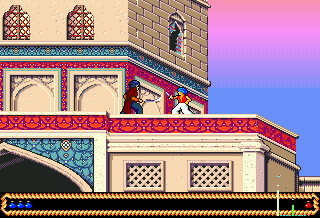
Prince of Persia is a 1989 cinematic platform game developed and published by Broderbund for the Apple II. It was designed and implemented by Jordan Mechner. Taking place in medieval Persia, players control an unnamed protagonist who must venture through a series of dungeons to defeat the evil Grand Vizier Jaffar and save an imprisoned princess.
Much like Karateka, Mechner's first video game, Prince of Persia used rotoscoping for its fluid and realistic animation. For this process, Mechner used as reference for the characters' movements videos of his brother doing acrobatic stunts in white clothes and swashbuckler films such as The Adventures of Robin Hood.
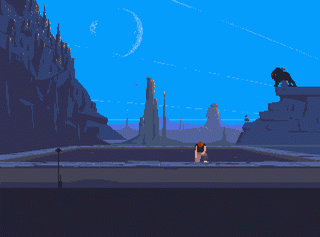
The game was critically acclaimed and, while not an immediate commercial success, sold many copies as it was ported to a wide range of platforms after the original Apple II release. It is believed to have been the first cinematic platformer and inspired many games in this subgenre, such as Another World. Its success launched the Prince of Persia franchise, consisting of two sequels, Prince of Persia 2: The Shadow and the Flame (1993) and Prince of Persia 3D (1999), and two reboots: Prince of Persia: The Sands of Time (2003), which was followed by three sequels of its own, and Prince of Persia (2008).
From Wikipedia's article Prince of Persia (1989 video game), licensed under CC BY-SA 4.0
Keyboard controls
| Genesis | Player 1 | Player 2 |
|---|---|---|
| D-pad | ↑↓←→ | IKJL |
| A | Z | N |
| B | X | M |
| C | C | , |
| X | A | Y |
| Y | S | U |
| Z | D | O |
| Mode | Shift | B |
| Start | Enter | Space |
Hotkeys
- 1 Quick save state
- 2 Quick load state
- 3 Change save slot
X, Y and Z are for six-button games such as Street Fighter II.
Gamepads are detected when you press a button. Remap any key from the emulator’s Controls menu (gear icon).
Live chat
Connecting…
Keyboard controls
| Genesis | Player 1 | Player 2 |
|---|---|---|
| D-pad | ↑↓←→ | IKJL |
| A | Z | N |
| B | X | M |
| C | C | , |
| X | A | Y |
| Y | S | U |
| Z | D | O |
| Mode | Shift | B |
| Start | Enter | Space |
Hotkeys
- 1 Quick save state
- 2 Quick load state
- 3 Change save slot
X, Y and Z are for six-button games such as Street Fighter II.
Gamepads are detected when you press a button. Remap any key from the emulator’s Controls menu (gear icon).
Comments