Montezuma’s Revenge
278K plays 1984 #Action#Platform
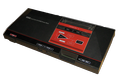
Montezuma's Revenge is a video game for Atari home computers, Atari 2600, Atari 5200, Apple II, ColecoVision, Commodore 64, IBM PC, Sega Master System, and ZX Spectrum (as Panama Joe). It was created by Robert Jaeger and published in 1984 by Parker Brothers. The game's title references a colloquial American English expression for diarrhea contracted while visiting Mexico. Montezuma's Revenge was one of the first platform games: an action game combining treasure hunting, multiple rooms, and puzzle solving.
The player controls a character called Panama Joe (a.k.a. Pedro), moving him from room to room in the labyrinthine underground of the 16th century Aztec temple of emperor Montezuma II, filled with enemies, obstacles, traps, and dangers. The objective is to score points by gathering jewels and killing enemies along the way. Panama Joe must find keys to open doors, collect and use equipment such as torches, swords, amulets, etc., and avoid or defeat the challenges in his path. Obstacles are laser gates, conveyor belts, disappearing floors and fire pits.
Movement is achieved by jumping, running, sliding down poles, and climbing chains and ladders. Enemies are skulls, snakes, and spiders. A further complication arises in the bottommost floors of each pyramid, which must be played in total darkness unless a torch is found.
The pyramid is nine floors deep, not counting the topmost entry room that the player drops into at the start of each level, and has 99 rooms to explore. The goal is to reach the Treasure Chamber, whose entrance is in the center room of the lowest level. After jumping in here, the player has a short time to jump from one chain to another and pick up as many jewels as possible. However, jumping onto a fireman's pole will immediately take the player to the next level; when time runs out, the player is automatically thrown onto the pole.
There are nine difficulty levels in all. Though the basic layout of the pyramid remains the same from one level to the next, small changes in details force the player to re-think strategy. These changes include:
Text: Wikipedia via RetroGames.cz, licensed under CC BY-SA 3.0
Keyboard controls
| SMS | Player 1 | Player 2 |
|---|---|---|
| D-pad | ↑↓←→ | IKJL |
| Button 1 | Z | N |
| Button 2 | X | M |
| Pause | Enter |
Hotkeys
- 1 Quick save state
- 2 Quick load state
- 3 Change save slot
Gamepads are detected when you press a button. Remap any key from the emulator’s Controls menu (gear icon).
Live chat
Connecting…
Keyboard controls
| SMS | Player 1 | Player 2 |
|---|---|---|
| D-pad | ↑↓←→ | IKJL |
| Button 1 | Z | N |
| Button 2 | X | M |
| Pause | Enter |
Hotkeys
- 1 Quick save state
- 2 Quick load state
- 3 Change save slot
Gamepads are detected when you press a button. Remap any key from the emulator’s Controls menu (gear icon).
Comments