Karateka
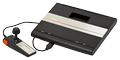
136K plays 1984 #Action#Fighting
Karateka is a 1984 martial arts action game written for the Apple II by Jordan Mechner. It is his first published game and was created while he was attending Yale University. The game was published in North America by Broderbund and in Europe by Ariolasoft. Along with Karate Champ and Yie Ar Kung-Fu (both also released in 1984), Karateka is one of the earliest martial arts fighting games. It was inspired by Japanese culture (Ukiyo-e art, Akira Kurosawa films, and manga comics) and by early Disney animated films and silent pictures. An influential game of its era, it was one of the first to use cinematic storytelling and sound design, and rotoscoped animation.
The player controls an unnamed protagonist attempting to rescue his love interest, a damsel in distress, Princess Mariko, from Akuma's castle fortress. The character walks and runs from left to right through a linear, side-scrolling level, dealing with attackers and obstacles, while moving deeper into the fortress. Each encounter with an enemy is one-on-one, as in a fighting game. Cinematic cuts show Mariko's situation and Akuma's actions before the player reaches them.
Karateka was ported to the Amstrad CPC, Atari 8-bit computers, Atari 7800, Atari ST, Commodore 64, MS-DOS, Nintendo Entertainment System, ZX Spectrum, PC-98, MSX, and Game Boy. Mechner led a remake, released in 2012, for Xbox 360, Microsoft Windows, PlayStation 3, and iOS.
From Wikipedia's article Karateka (video game)
Keyboard controls
| Atari 7800 | Player 1 | Player 2 |
|---|---|---|
| D-pad | ↑↓←→ | IKJL |
| Button 1 | Z | N |
| Button 2 | X | M |
| Select | Shift | |
| Reset | Enter | |
| Pause | P |
Hotkeys
- 1 Quick save state
- 2 Quick load state
- 3 Change save slot
Gamepads are detected when you press a button. Remap any key from the emulator’s Controls menu (gear icon).
From the manual, pages 2–3
Live chat
Connecting…
Keyboard controls
| Atari 7800 | Player 1 | Player 2 |
|---|---|---|
| D-pad | ↑↓←→ | IKJL |
| Button 1 | Z | N |
| Button 2 | X | M |
| Select | Shift | |
| Reset | Enter | |
| Pause | P |
Hotkeys
- 1 Quick save state
- 2 Quick load state
- 3 Change save slot
Gamepads are detected when you press a button. Remap any key from the emulator’s Controls menu (gear icon).
From the manual, pages 2–3
3.0 Good job
Players 69 · 439 votes
No critic scores found for this game: this is the players' rating.
Review scorecard
- Graphics 3.0 out of 5 Overall fallback
- Sound 3.0 out of 5 Overall fallback
- Control 3.0 out of 5 Overall fallback
- Fun Factor 3.0 out of 5 Overall fallback
Overall fallback: Players 69 · 439 votes. The same 69/100 overall rating fills missing categories using the face scale; these are not separate category scores. Player rating; no critic scores available.
What the reviews talk about
Key wordsstunningbeautifulfunrealisticenjoyableaddictive
What the critics said
In October 1985, Compute! called Karateka "a nominee for the Most Underrated Program of the Year. It's a program that must be seen to be fully appreciated".
— Compute!
Rick Teverbaugh reviewed the game for Computer Gaming World in April 1986, stating it is more "like an adventure game with karate thrown in" compared to Karate Champ and Kung-Fu Master (1984), and that it "resembles a Chuck Norris movie in flavor".
— Computer Gaming World, 1986
According to Dragon, "this game has a great plot, animation that'll dazzle your eyes, and player-controlled martial arts action".
— Dragon, 1987
Computer Entertainer later rated the Commodore 64 version seven out of eight stars in July 1985, praising the "visually stunning" graphics and "authentic" moves, but again questioning "the use of a blond hero and heroine in a Japanese setting".
— Computer Entertainer, 1985 · about another version
From the Reception section of Wikipedia's Karateka (video game) article.
Comments