Cookie Monster Munch
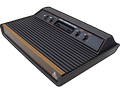
6.9K plays 1983 #Educational
Cookie Monster Munch is an educational video game developed by Atari, Inc. in collaboration with the Children’s Computer Workshop for the Atari 2600, released in 1983 as part of a series of Sesame Street–themed titles aimed at young children. The game stars the beloved Muppet character Cookie Monster, and was programmed by Gary Stark. It was designed to use the optional Atari Kid’s Controller with a keypad overlay to make gameplay accessible for early childhood audiences, though the regular keyboard controller could also be used.
The gameplay centers around simple maze navigation and collection objectives. In the first six levels, players guide Cookie Monster through a maze to collect cookies scattered around the screen and carry them back to a cookie jar at the bottom. As players progress through these levels, Cookie Monster moves more quickly and can carry multiple cookies back to the jar before depositing them, increasing both challenge and engagement.
In the final four stages, the focus shifts: players control a character known as the Cookie Kid, who must gather cookies while Cookie Monster pursues him through increasingly complex mazes, creating a competitive dynamic that adds variety to the gameplay experience. Throughout all ten game variations, the objective remains clear and child-friendly, emphasizing directional movement and simple problem-solving over reflex-based action.
Cookie Monster Munch was marketed not only as entertainment but also as an educational tool. According to the game’s manual, the maze navigation and directional control exercises were intended to reinforce early prereading skills, hand-eye coordination, and a child’s understanding of relational concepts such as left, right, up, and down. It was one of several Atari titles developed under the CCW label with similar goals.
Reception of Cookie Monster Munch has been mixed in retrospective coverage. While some players remember the game fondly for its charming use of the Sesame Street license and its appeal to very young audiences, others critique it for simplicity and limited depth by later standards. Nonetheless, it remains a notable example of early educational gaming and Atari’s efforts to respond to concerns about video game content by producing nonviolent, child-oriented software.
Text: RetroGames.cz, licensed under CC BY-SA 3.0
Keyboard controls
| Atari 2600 | Player 1 | Player 2 |
|---|---|---|
| D-pad | ↑↓←→ | IKJL |
| Fire | Z | N |
| Game Select | Shift | |
| Game Reset | Enter |
Hotkeys
- 1 Quick save state
- 2 Quick load state
- 3 Change save slot
Most games start with Game Reset. Paddle games (Breakout, Kaboom!…) need a gamepad stick.
Gamepads are detected when you press a button. Remap any key from the emulator’s Controls menu (gear icon).
Live chat
Connecting…
Keyboard controls
| Atari 2600 | Player 1 | Player 2 |
|---|---|---|
| D-pad | ↑↓←→ | IKJL |
| Fire | Z | N |
| Game Select | Shift | |
| Game Reset | Enter |
Hotkeys
- 1 Quick save state
- 2 Quick load state
- 3 Change save slot
Most games start with Game Reset. Paddle games (Breakout, Kaboom!…) need a gamepad stick.
Gamepads are detected when you press a button. Remap any key from the emulator’s Controls menu (gear icon).
Comments