Amidar
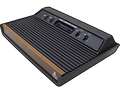
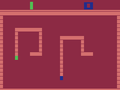
Amidar is a 1982 maze video game developed and published by Konami for arcades. It was released in North America by Stern. Parker Brothers published an Atari 2600 version in late 1982, and Casio released a port for the PV-1000 in 1983. Amidar was the first in the grid capture sub-genre of maze games and was highly cloned in arcades and for home systems.
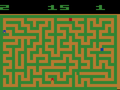
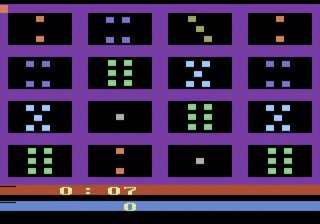
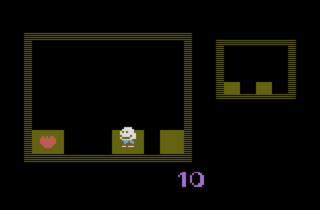
The player moves around a fixed rectilinear lattice, changing the color of the lines, while avoiding enemies. Coloring all the lines around a rectangle fills it in. When all the rectangles have been filled, the player moves to the next level. There are two types of levels which alternate, with the player controlling a paint roller in one and a gorilla in the other.
The game and its name have their roots in the Japanese lot drawing game Amidakuji. The bonus level in Amidar is a nearly exact replication of an Amidakuji game and the way the enemies move conform to the Amidakuji rules; this is referred to in the attract mode as "Amidar movement".
From Wikipedia's article Amidar
Keyboard controls
| Atari 2600 | Player 1 | Player 2 |
|---|---|---|
| D-pad | ↑↓←→ | IKJL |
| Fire | Z | N |
| Game Select | Shift | |
| Game Reset | Enter |
Hotkeys
- 1 Quick save state
- 2 Quick load state
- 3 Change save slot
Most games start with Game Reset. Paddle games (Breakout, Kaboom!…) need a gamepad stick.
Gamepads are detected when you press a button. Remap any key from the emulator’s Controls menu (gear icon).
From the manual, page 2
Live chat
Connecting…
Keyboard controls
| Atari 2600 | Player 1 | Player 2 |
|---|---|---|
| D-pad | ↑↓←→ | IKJL |
| Fire | Z | N |
| Game Select | Shift | |
| Game Reset | Enter |
Hotkeys
- 1 Quick save state
- 2 Quick load state
- 3 Change save slot
Most games start with Game Reset. Paddle games (Breakout, Kaboom!…) need a gamepad stick.
Gamepads are detected when you press a button. Remap any key from the emulator’s Controls menu (gear icon).
From the manual, page 2
2.5 Could be better
Players 60 · 118 votes
No critic scores found for this game: this is the players' rating.
Review scorecard
- Graphics 2.5 out of 5 Overall fallback
- Sound 2.5 out of 5 Overall fallback
- Control 2.5 out of 5 Overall fallback
- Fun Factor 2.5 out of 5 Overall fallback
Overall fallback: Players 60 · 118 votes. The same 60/100 overall rating fills missing categories using the face scale; these are not separate category scores. Player rating; no critic scores available.
Full reviews
Go live
Let anyone watch you play, live in their browser. They see your game as you play it.
Press Start Game first.
Comments