Woody Pop
4.3K plays 1987 #Action
Woody Pop is a block-breaking video game developed and published by Sega for the Sega Master System in Japan in 1987 and later released internationally for the Game Gear in 1991. Part of Sega’s early effort to bring arcade-style action to its home systems, it belongs to the genre popularized by Breakout and later expanded by Arkanoid, adopting their core paddle-and-ball mechanics while introducing its own thematic elements and level progression.
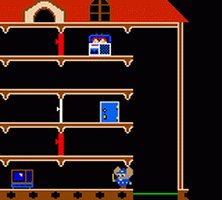
In Woody Pop, players control a smiling wooden log named Woody, a tree spirit who must clear rooms of bricks laid out within the Enchanted Mansion’s toy factory. The objective in each level is to bounce a ball off Woody so that it ricochets against blocks, breaking them to clear the room; letting the ball fall into the pit below costs a life. Unlike the simpler Breakout, Woody Pop incorporates a variety of brick types and power-ups that affect ball behavior and the paddle’s abilities, drawing clear inspiration from Arkanoid’s enhancements to the basic breakout formula.
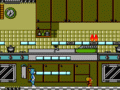
Special blocks release various power-ups — including multi-ball, flame balls, enlarged paddles, and projectiles — which can aid in clearing levels more efficiently. Certain bricks also release obstacles such as toy soldiers and robots that interfere with the ball’s path, adding an extra layer of challenge beyond mere brick destruction. Some screens even feature moving hazards like toy trains crossing the playfield, further testing the player’s timing and precision.
A notable design choice in Woody Pop is its non-linear level progression: after clearing a room, players may be presented with up to three adjacent rooms and can choose their path forward. Across the course of the game, there are fifty distinct rooms before the final confrontation with the Mad Machine, the antagonist responsible for obstructing the toy factory. This branching structure offers players strategic choice and replayability uncommon in many other Breakout-style games of the era.
Reception of Woody Pop has been mixed. Retrospective reviews often praise its colorful graphics, personality, and large variety of power-ups as giving the game charm and depth beyond simple brick-breaking, but some criticize its pacing and design choices as less engaging compared to other entries in the genre. While not achieving the enduring legacy of Arkanoid, Woody Pop remains noted among Sega’s early Master System and Game Gear libraries as a distinctive interpretation of the breakout formula.
Text: RetroGames.cz, licensed under CC BY-SA 3.0
Keyboard controls
| Game Gear | Player 1 |
|---|---|
| D-pad | ↑↓←→ |
| Button 1 | Z |
| Button 2 | X |
| Start | Enter |
Hotkeys
- 1 Quick save state
- 2 Quick load state
- 3 Change save slot
Gamepads are detected when you press a button. Remap any key from the emulator’s Controls menu (gear icon).
Live chat
Connecting…
Keyboard controls
| Game Gear | Player 1 |
|---|---|
| D-pad | ↑↓←→ |
| Button 1 | Z |
| Button 2 | X |
| Start | Enter |
Hotkeys
- 1 Quick save state
- 2 Quick load state
- 3 Change save slot
Gamepads are detected when you press a button. Remap any key from the emulator’s Controls menu (gear icon).






Comments