Tetris
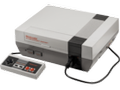
326K plays 1989 #Puzzle
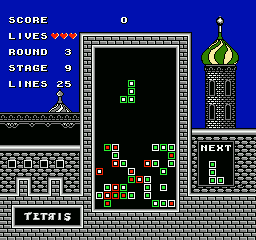
Tetris, commonly known as Tengen Tetris, is a puzzle game developed by Atari Games and published under its Tengen label for the Nintendo Entertainment System. Released in North America on May 17, 1989, it was adapted from Atari Games’ arcade version and carried the subtitle The Soviet Mind Game. Although Tengen believed that it had obtained the necessary console rights through an existing chain of licences, Nintendo challenged those rights in court. The cartridge therefore remained on sale for only about four weeks before its distribution was prohibited.
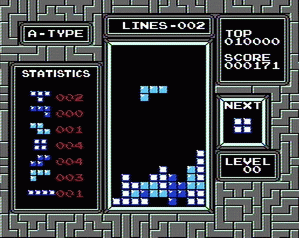
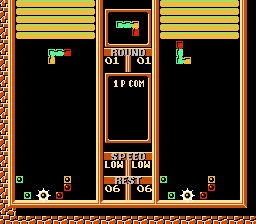
The fundamental gameplay follows Alexey Pajitnov’s original design. Tetrominoes descend into a ten-by-twenty-square playfield and must be moved and rotated to form complete horizontal lines. Cleared lines disappear, the blocks above them move downward and additional points are awarded for removing several lines at once. Unlike the earlier Bullet-Proof Software version for the Famicom, the controls use the directional pad to move pieces sideways or accelerate their descent, while the buttons rotate them in either direction. There is no instantaneous hard drop.
The single-player game is an endless challenge in which the speed gradually increases as more lines are cleared. Levels initially advance after every 30 lines and later at longer intervals, with the maximum speed reached at level 17. The presentation closely resembles the Atari arcade game, using coloured geometric patterns, Russian-inspired imagery and music composed by Brad Fuller. A preview window displays the next piece, allowing the player to plan placements in advance.
Its greatest advantage over Nintendo’s later NES edition is the extensive selection of multiplayer modes. Two players can compete simultaneously on separate playfields, receiving identical sequences of pieces and attempting to survive longer than their opponent. The game also offers competition against a computer-controlled player. Most unusually, two human players—or one person assisted by the computer—can cooperate inside a shared twelve-square-wide playfield, each controlling a separate falling piece. Coordinating two tetrominoes at once creates a distinctive form of Tetris that few contemporary versions offered.
On June 22, 1989, a federal court granted Nintendo a preliminary injunction after determining that the companies from which Atari derived its licence had not received console rights from the Soviet agency Elorg. Tengen recalled the game the following day, and most of the remaining cartridges were destroyed; approximately 100,000 copies had already been sold. The resulting rarity made Tengen Tetris a valuable collector’s item, but its reputation rests on more than the legal dispute. Responsive controls, arcade-style progression and exceptionally strong multiplayer options make it one of the most accomplished early versions of Tetris and, in several respects, a more complete game than Nintendo’s official NES release.
Text: RetroGames.cz, licensed under CC BY-SA 3.0
Keyboard controls
| NES | Player 1 | Player 2 |
|---|---|---|
| D-pad | ↑↓←→ | IKJL |
| B | Z | N |
| A | X | M |
| Select | Shift | B |
| Start | Enter | Space |
Hotkeys
- 1 Quick save state
- 2 Quick load state
- 3 Change save slot
Gamepads are detected when you press a button. Remap any key from the emulator’s Controls menu (gear icon).
Comments