Psion Chess
39K plays 1985 #Puzzle
Psion Chess is a computer chess program written by British programmer Richard Lang and released for several home-computer platforms during the 1980s. It originated as a successor to Lang’s earlier Cyrus program and was first marketed by Sinclair Research for the Sinclair QL. Versions were subsequently produced for IBM-compatible PCs, the Apple Macintosh and Atari ST. Lang wrote the original program in assembly language, adapting it for computers based on Motorola 68000 and Intel 8086 processors.
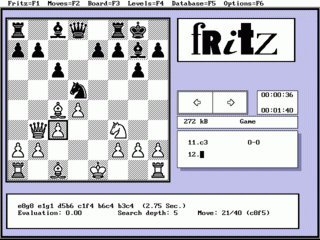
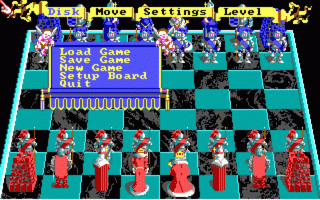
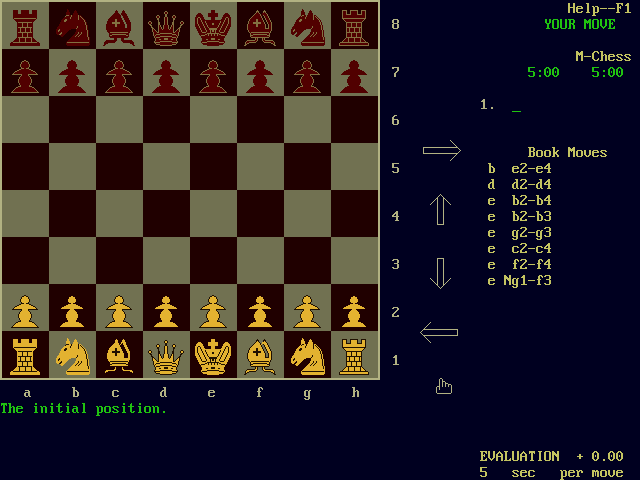
The program allows the player to compete against the computer, play against another person or instruct the computer to analyse both sides of a game. Several playing levels determine how much time the program is given to calculate its moves, ranging from very fast responses to extended analysis. An unusual “Equal” setting allows Psion Chess to use approximately the same amount of thinking time as its human opponent. Games and positions can be saved, reconstructed or analysed, making the program useful for chess study as well as ordinary play.
Depending on the platform, the board can be displayed in either two or three dimensions. The later Macintosh and Atari ST editions use mouse-controlled graphical interfaces, while the Atari ST version also supports six languages and provides built-in help. The presentation is restrained compared with the animated pieces of Battle Chess or some editions of The Chessmaster, but the pieces are clearly recognizable and the program concentrates primarily on the quality of its computer opponent.
Playing strength was the principal attraction of Psion Chess. The program shared first place at the 1984 World Microcomputer Chess Championship in Glasgow and won the software category of the same championship in 1987. Its search combined conventional examination of variations with selective extensions and a comparatively detailed evaluation of positional factors. In a 1987 tournament organized by START magazine, the Atari ST version comfortably defeated both The Chessmaster 2000 and TechMate and produced an estimated expert-level performance, although the magazine cautioned that the number and speed of the games were insufficient for an official rating.
Psion Chess is also important because it formed part of a highly successful family of programs created by Richard Lang. Its technology was used as the basis for his early Mephisto chess computers, beginning with Mephisto Amsterdam, which won the 1985 World Microcomputer Chess Championship. Lang continued to dominate computer-chess competitions with later Mephisto models and eventually developed ChessGenius. Although Psion Chess offers fewer decorative features than some of its contemporaries, its strong and relatively human-like play made it one of the most accomplished microcomputer chess programs of its period.
Text: RetroGames.cz, licensed under CC BY-SA 3.0
Controls
This is a PC game: it uses the keyboard the way it did under MS-DOS, and the mouse where the game supports it. Click the game screen first so it gets your key presses.
Many DOS games start with a menu or ask a question first — read the screen and answer with the keyboard. Arrow keys, Enter, Space, Ctrl and Alt are the usual game keys.
Live chat
Connecting…
Controls
This is a PC game: it uses the keyboard the way it did under MS-DOS, and the mouse where the game supports it. Click the game screen first so it gets your key presses.
Many DOS games start with a menu or ask a question first — read the screen and answer with the keyboard. Arrow keys, Enter, Space, Ctrl and Alt are the usual game keys.
Comments