OutRun
770K plays 1986 #Racing
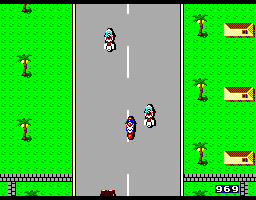
Out Run is a 1986 racing video game developed and published by Sega for arcades. It is known for its pioneering hardware and graphics, nonlinear gameplay, a selectable soundtrack with music composed by Hiroshi Kawaguchi, and the hydraulic motion simulator deluxe arcade cabinet. The goal is to avoid traffic and reach one of five destinations before time runs out.
Out Run was designed by Yu Suzuki, who traveled to Europe to gain inspiration for the stages. Suzuki's original concept was to base it on the 1981 American film The Cannonball Run, of which he was a fan. He disliked racing games in which cars exploded on impact, and wanted gamers to enjoy the experience of driving and to feel "superior".
Suzuki had a small team and only ten months to program Out Run, leaving him to do most of the work himself. It was a critical and commercial success, becoming the highest-grossing arcade game of 1987 worldwide, as well as Sega's most successful arcade cabinet of the 1980s. It was ported to numerous video game consoles and home computers, becoming one of the best-selling video games at the time and selling millions of copies worldwide. Out Run is considered one of the greatest games and is cited as an influence upon numerous games, playing a role in the arcade industry's recovery, and providing the name for a subgenre of synthwave. It was followed by several sequels, beginning with Turbo OutRun in 1989.
From Wikipedia's article Out Run
Keyboard controls
| SMS | Player 1 | Player 2 |
|---|---|---|
| D-pad | ↑↓←→ | IKJL |
| Button 1 | Z | N |
| Button 2 | X | M |
| Pause | Enter |
Hotkeys
- 1 Quick save state
- 2 Quick load state
- 3 Change save slot
Gamepads are detected when you press a button. Remap any key from the emulator’s Controls menu (gear icon).
From the manual, pages 6–7
Live chat
Connecting…
Keyboard controls
| SMS | Player 1 | Player 2 |
|---|---|---|
| D-pad | ↑↓←→ | IKJL |
| Button 1 | Z | N |
| Button 2 | X | M |
| Pause | Enter |
Hotkeys
- 1 Quick save state
- 2 Quick load state
- 3 Change save slot
Gamepads are detected when you press a button. Remap any key from the emulator’s Controls menu (gear icon).
From the manual, pages 6–7
4.0 Great job!
Critics 84 · 5 reviews
Review scorecard
- Graphics 4.0 out of 5 Overall fallback
- Sound 4.0 out of 5 Overall fallback
- Control 4.0 out of 5 Overall fallback
- Fun Factor 4.0 out of 5 Overall fallback
Overall fallback: Critics 84 · 5 reviews. Overall source The same 84/100 overall rating fills missing categories using the face scale; these are not separate category scores.
What the reviews talk about
Key wordsoriginalpolishedinnovativerealisticdetailedenjoyable
What the critics said
Top Score called it "the most enjoyable" and "realistic driving video game ever created" and praised its innovative simulator cabinet, detailed visuals, and stereo soundtrack.
— Score, 1987
In Your Sinclair, Peter Shaw praised its realism and described it as "the most frighteningly fast road race game" he had played.
— Your Sinclair, 1987
Computer and Video Games praised the Master System release, with the writers concluding that it had "all the thrill power of the arcade version".
— Computer and Video Games, 1987
Reviewers for Dragon described it as a "refreshing" game "that provides hours of entertainment".
— Dragon, 1988
From the Reception section of Wikipedia's Out Run article.
Scores
- 90 Computer and Video Games1987 9/10; 24/40; 8/40 (CPC); 7/10; 70%
- 90 Dragon1988 4.5/5
- 85 ACE1987 852/1000; 610/1000; 873/1000; 822/1000
- 82 Génération 41988 82%; 78%
- 72 The Games Machine (UK)1988 72%; 67%; 61%; 79%; 75%
- 90 Joypad1991 90% · other versions
- 85 Joystick 79%; 90% · other versions
- 81 Sinclair User1990 81% · other versions
- 80 Your Sinclair1988 8/10 · other versions
- 79 Commodore User1987 true ;; 9/10; 67% · other versions
- 72 Crash 72% · other versions
- 37 Amstrad Action 37% (CPC) · other versions
From the review table in Wikipedia's Out Run article.
Comments