Hang-On
58K plays 1985 #Racing
Hang-On is a 1985 racing video game developed and published by Sega for arcades. In the game, the player controls a motorcycle against time and other computer-controlled bikes. It was one of the first arcade games to use 16-bit graphics and uses the Super Scaler arcade system board, created with design input from Yu Suzuki, as technology to simulate 3D effects. The deluxe cabinet version also introduced a motion-controlled arcade cabinet, where the player's body movement on a large motorbike-shaped cabinet corresponds with the player character's movements on screen.
Yu Suzuki began development of Hang-On after deciding to design a motorcycle racing game as a way to use a torsion bar in an arcade game. With market research suggesting GP 500 racing was popular, Suzuki took inspiration from world champion Freddie Spencer and his style of racing. The game's soundtrack was written by Hiroshi Kawaguchi, who used rock music that was uncommon in arcade games at the time. Following its initial release for arcades, Hang-On was ported to Sega's Master System and SG-1000 consoles, as well as to the MSX and PC-88 computers.
Hang-On was very popular at launch and sold well for Sega, becoming the highest-grossing arcade video game of 1985 in the United States and then the highest-grossing arcade game of 1986 in both Japan and the United States. It received a positive critical reception for its realism, graphics, bike cabinet and physical controls, though there was some initial controversy in Japan over modesty concerns involving female players with the bike cabinet. The game started the trend of 'taikan' motion simulator games in the late 1980s, which Sega followed with hits such as Space Harrier (1985), Out Run (1986) and After Burner (1987); this helped the arcade video game market recover during the late 1980s. Hang-On has been recognized as a well-remembered and influential arcade game. Several sequels were later made for arcades, as well as video game consoles.
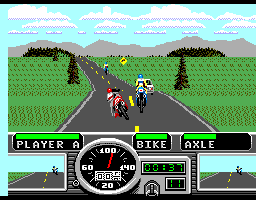
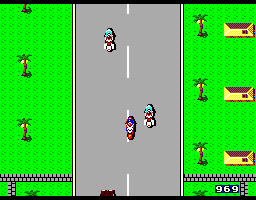
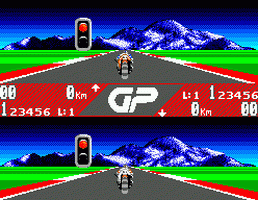
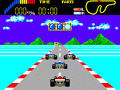
Using a behind the motorcycle perspective, the player races a linear race track divided into several stages within a limited time. Players have to lean the motorcycle to turn, with tighter corners requiring a further lean. A throttle similar to a motorcycle has to be twisted to accelerate the bike. The game has one track, pieced together in segments. Reaching a checkpoint at the end of each segment extends the time limit, and remaining time is carried over into the next stage. Running off the track results in the motorcycle crashing and the rider is launched into the air. The game ends if the time runs out or all five stages are completed.
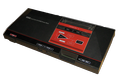
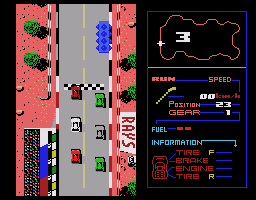
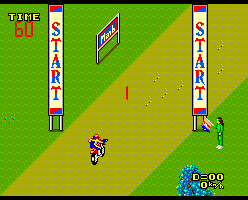
A version of the game for the SG-1000 released in 1985 was marketed as a sequel, Hang-On II, though it was essentially a port of the original game simplified to work within the limitations of the console hardware. An upgraded port for the Master System was produced in the same year in Japan, and then was released a year later in 1986 for North America, as the system's pack-in game along with Safari Hunt in a multicart. An additional arcade version based on the Master System port, titled Hang-On Jr., was released in 1986 for Sega's System E arcade system board. The game was also released on the MSX in 1985.
Text: Wikipedia via RetroGames.cz, licensed under CC BY-SA 3.0
Keyboard controls
| SMS | Player 1 | Player 2 |
|---|---|---|
| D-pad | ↑↓←→ | IKJL |
| Button 1 | Z | N |
| Button 2 | X | M |
| Pause | Enter |
Hotkeys
- 1 Quick save state
- 2 Quick load state
- 3 Change save slot
Gamepads are detected when you press a button. Remap any key from the emulator’s Controls menu (gear icon).
Live chat
Connecting…
Keyboard controls
| SMS | Player 1 | Player 2 |
|---|---|---|
| D-pad | ↑↓←→ | IKJL |
| Button 1 | Z | N |
| Button 2 | X | M |
| Pause | Enter |
Hotkeys
- 1 Quick save state
- 2 Quick load state
- 3 Change save slot
Gamepads are detected when you press a button. Remap any key from the emulator’s Controls menu (gear icon).
Comments