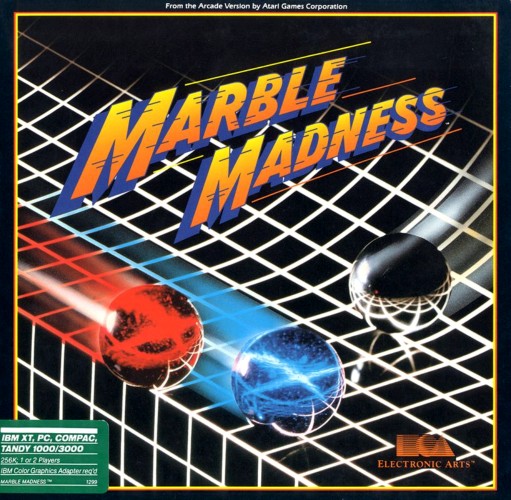
Marble Madness
49K plays 1984 #Action
Marble Madness is a 1984 platform game designed by Mark Cerny and published by Atari Games Inc. for arcades. Set in an isometric perspective, the game tasks the player with guiding a marble through six courses, populated with obstacles and enemies, within a time limit. The player controls the marble by using a trackball. Marble Madness is known for using innovative game technologies: it was Atari's first to use the Atari System 1 hardware, the first to be programmed in the C programming language, and one of the first to use true stereo sound (previous games used either monaural sound or simulated stereo).
In designing the game, Cerny drew inspiration from miniature golf, racing games, and the art of M. C. Escher. He aimed to create a game that offered a distinct experience with a unique control system. Cerny applied a minimalist approach in designing the appearance of the game's courses and enemies. Throughout development, he was frequently impeded by limitations in technology and had to forgo several design ideas.
Upon its release in arcades, Marble Madness was commercially successful and profitable. Critics praised the game's difficulty, unique visual design, and stereo soundtrack. The game was ported to numerous platforms and inspired the development of several similar games. A sequel was developed and planned for release in 1991, but was canceled when location testing showed it could not succeed in competition with other titles.
From Wikipedia's article Marble Madness
Controls
This is a PC game: it uses the keyboard the way it did under MS-DOS, and the mouse where the game supports it. Click the game screen first so it gets your key presses.
Many DOS games start with a menu or ask a question first — read the screen and answer with the keyboard. Arrow keys, Enter, Space, Ctrl and Alt are the usual game keys.
Live chat
Connecting…
Controls
This is a PC game: it uses the keyboard the way it did under MS-DOS, and the mouse where the game supports it. Click the game screen first so it gets your key presses.
Many DOS games start with a menu or ask a question first — read the screen and answer with the keyboard. Arrow keys, Enter, Space, Ctrl and Alt are the usual game keys.
3.5 Good job
Players 77 · 226 votes
No critic scores found for this game: this is the players' rating.
Review scorecard
- Graphics 3.5 out of 5 Overall fallback
- Sound 3.5 out of 5 Overall fallback
- Control 3.5 out of 5 Overall fallback
- Fun Factor 3.5 out of 5 Overall fallback
Overall fallback: Players 77 · 226 votes. The same 77/100 overall rating fills missing categories using the face scale; these are not separate category scores. Player rating; no critic scores available.
What the reviews talk about
Key wordsoriginalengagingcreativefaithfulshortexcellent
Comments