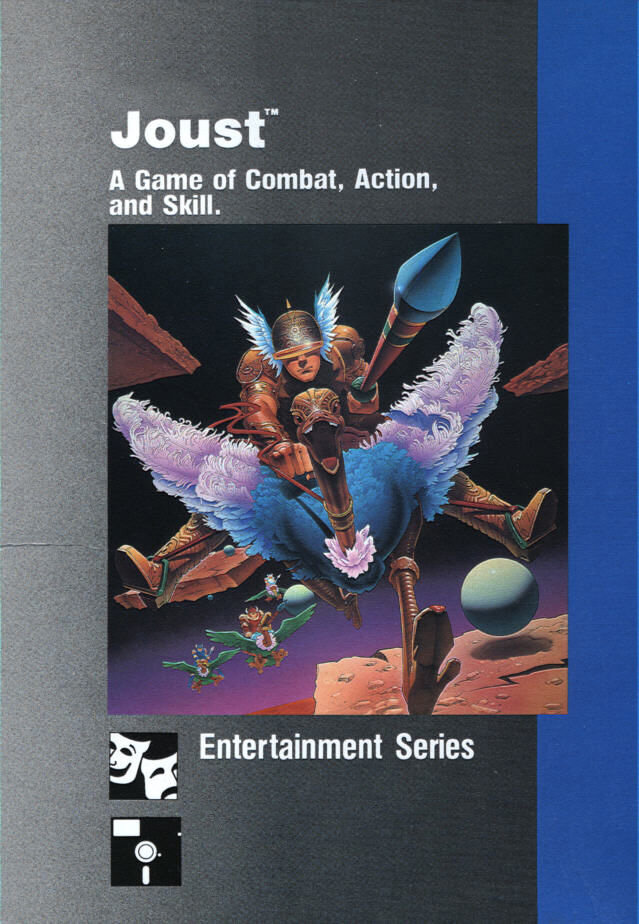
Joust
209K plays 1982 #Action
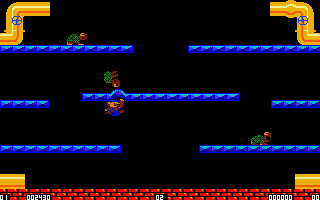
Joust is a 1982 action game developed and published by Williams Electronics for arcades. Players assume the role of knights armed with lances and mounted on large birds (an ostrich for Player 1 and a stork for Player 2). They progress through levels, which consist of a single screen filled with floating platforms, by defeating enemy knights riding buzzards and other opponents.
Using the computer hardware from the company's earlier arcade game, Defender, John Newcomer led the development team: Bill Pfutzenreuter, Janice Woldenberg-Miller (née Hendricks), Python Anghelo, Tim Murphy, and John Kotlarik. Newcomer aimed to create a flying game, with cooperative two-player gameplay, while avoiding the overdone space theme. After deciding to use birds as characters, he forwent the standard eight-direction joystick control scheme and devised collisions as the means of combat.
The game was well-received by players and critics, and the mechanics influenced other games. Praise focused on the unique premise and enjoyable gameplay. While not the first two-player cooperative video game, Joust's success and polished implementation helped popularize the concept. It was followed by a less popular arcade sequel in 1986: Joust 2: Survival of the Fittest. While Joust was ported to numerous home systems and included in several multiplatform retro game anthologies, efforts to adapt it to other media and create updated video game remakes have been fruitless.
From Wikipedia's article Joust (video game)
Controls
This is a PC game: it uses the keyboard the way it did under MS-DOS, and the mouse where the game supports it. Click the game screen first so it gets your key presses.
Many DOS games start with a menu or ask a question first — read the screen and answer with the keyboard. Arrow keys, Enter, Space, Ctrl and Alt are the usual game keys.
Live chat
Connecting…
Controls
This is a PC game: it uses the keyboard the way it did under MS-DOS, and the mouse where the game supports it. Click the game screen first so it gets your key presses.
Many DOS games start with a menu or ask a question first — read the screen and answer with the keyboard. Arrow keys, Enter, Space, Ctrl and Alt are the usual game keys.
4.0 Great job!
Critics 82 · 4 reviews (other versions)
From reviews of other versions of the game (none of this one found).
Review scorecard
- Graphics 4.0 out of 5 Overall fallback
- Sound 4.0 out of 5 Overall fallback
- Control 4.0 out of 5 Overall fallback
- Fun Factor 4.0 out of 5 Overall fallback
Overall fallback: Critics 82 · 4 reviews (other versions). Overall source The same 82/100 overall rating fills missing categories using the face scale; these are not separate category scores. From reviews of other versions of the game.
What the reviews talk about
Key wordsweirdcreativeoriginalenjoyableaddictivememorable
What the critics said
The staff concluded that Joust was "Atari's finest since Star Raiders" in 1980.
— Antic, 1984
Retro Gamer writer Mike Bevan called the game's physics "beautifully" realized and described Joust as one of the "most remarkable and well-loved titles" of the Williams library.
— Retro Gamer, 2009 (Mike Bevan)
Antic magazine writers called the Atari 8-bit version a "unique, addictive arcade game" that was "almost identical" to the original.
— Antic · about another version
Reviewing the NES port, Allgame's Skyler Miller noted that the "essential gameplay is intact" but complained about the omission of the arcade version's extra features.
— AllGame (Skyler Miller) · about another version
From the Reception section of Wikipedia's Joust (video game) article.
Scores
- 100 Play Meter1982 Arcade: 4/4 · other versions
- 83 Computer and Video Games1989 Atari 2600: 83% · other versions
- 77 AllGame Arcade: 5/5 ; Atari 7800: 4/5 ; NES: 2.5/5 · other versions
- 67 Tilt1983 Arcade: 4/6 · other versions
From the review table in Wikipedia's Joust (video game) article.
Comments