Karateka
133K plays 1984 #Action#Fighting
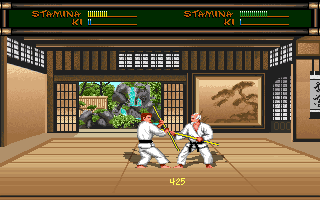
Karateka is a 1984 martial arts action game written for the Apple II by Jordan Mechner. It is his first published game and was created while he was attending Yale University. The game was published in North America by Broderbund and in Europe by Ariolasoft. Along with Karate Champ and Yie Ar Kung-Fu (both also released in 1984), Karateka is one of the earliest martial arts fighting games. It was inspired by Japanese culture (Ukiyo-e art, Akira Kurosawa films, and manga comics) and by early Disney animated films and silent pictures. An influential game of its era, it was one of the first to use cinematic storytelling and sound design, and rotoscoped animation.
The player controls an unnamed protagonist attempting to rescue his love interest, a damsel in distress, Princess Mariko, from Akuma's castle fortress. The character walks and runs from left to right through a linear, side-scrolling level, dealing with attackers and obstacles, while moving deeper into the fortress. Each encounter with an enemy is one-on-one, as in a fighting game. Cinematic cuts show Mariko's situation and Akuma's actions before the player reaches them.
Karateka was ported to the Amstrad CPC, Atari 8-bit computers, Atari 7800, Atari ST, Commodore 64, MS-DOS, Nintendo Entertainment System, ZX Spectrum, PC-98, MSX, and Game Boy. Mechner led a remake, released in 2012, for Xbox 360, Microsoft Windows, PlayStation 3, and iOS.
From Wikipedia's article Karateka (video game), licensed under CC BY-SA 4.0
Controls
This is a PC game: it uses the keyboard the way it did under MS-DOS, and the mouse where the game supports it. Click the game screen first so it gets your key presses.
Many DOS games start with a menu or ask a question first — read the screen and answer with the keyboard. Arrow keys, Enter, Space, Ctrl and Alt are the usual game keys.
Live chat
Connecting…
Controls
This is a PC game: it uses the keyboard the way it did under MS-DOS, and the mouse where the game supports it. Click the game screen first so it gets your key presses.
Many DOS games start with a menu or ask a question first — read the screen and answer with the keyboard. Arrow keys, Enter, Space, Ctrl and Alt are the usual game keys.
Comments