Cyberchess
25K plays 1992 #Puzzle
Cyberchess, also released as Cyberchess: The Ultimate Game of Power, is a computer chess game developed by Gamer’s Edge and published by Softdisk for MS-DOS in 1992. It combines the rules of traditional chess with a futuristic visual style inspired by electronic worlds and science-fiction combat. The development credits include several notable members of the Gamer’s Edge team, including John Carmack, John Romero, Mike Maynard and James T. Row.
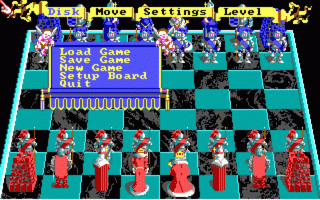
The game follows the standard rules of chess, but replaces the familiar wooden pieces with brightly coloured robotic and humanoid figures. Its board is viewed from above and resembles an electronic grid, with the pieces positioned at intersections rather than in the centres of conventional squares. This unusual arrangement can initially make the board more difficult to read, although it does not alter the movement or function of the individual pieces.
A separate window displays a larger portrait of the currently selected piece, helping the player distinguish between the stylized units. When one piece captures another, the game presents a short combat sequence in which the victorious character destroys its opponent. These scenes invite comparison with Interplay’s Battle Chess, although Cyberchess uses much simpler graphics and animations. Its science-fiction setting also anticipated the more elaborate presentation of Battle Chess 4000, which appeared during the same year.
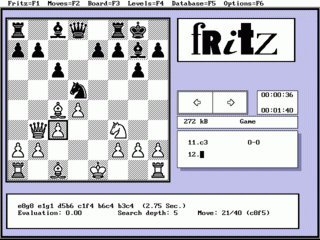
Players can compete against the computer or another human participant. The program includes several playing levels, move suggestions and a record of previously played games. It recognizes standard chess situations such as check and supports special rules including castling, en passant captures and pawn promotion. At higher difficulty settings the computer may require a considerable amount of time to calculate its moves, reflecting both the ambitions of the chess engine and the limited speed of contemporary personal computers.
Cyberchess received little documented coverage from professional magazines and remains one of the more obscure releases associated with Gamer’s Edge. Its artificial intelligence and range of options are less sophisticated than those offered by specialized chess programs of the period, while its combat animations cannot match the variety of Battle Chess. Nevertheless, the electronic board, robotic pieces and distinctive presentation give it an identity of its own. The game is also historically interesting because its credits connect it with developers who had already worked on Commander Keen and Wolfenstein 3D and would soon help create Doom.
Text: RetroGames.cz, licensed under CC BY-SA 3.0
Controls
This is a PC game: it uses the keyboard the way it did under MS-DOS, and the mouse where the game supports it. Click the game screen first so it gets your key presses.
Many DOS games start with a menu or ask a question first — read the screen and answer with the keyboard. Arrow keys, Enter, Space, Ctrl and Alt are the usual game keys.
Live chat
Connecting…
Controls
This is a PC game: it uses the keyboard the way it did under MS-DOS, and the mouse where the game supports it. Click the game screen first so it gets your key presses.
Many DOS games start with a menu or ask a question first — read the screen and answer with the keyboard. Arrow keys, Enter, Space, Ctrl and Alt are the usual game keys.
Comments