Chess
37K plays 1981 #Puzzle
Chess, also known as Chess C.4, is an early computer chess program originally written in BASIC-80 by American programmer Michael C. Rakaska in March 1980. The code was subsequently revised by Ted Lester, while S. W. Huggins adapted it for the IBM PC. This version was published by International PC Owners in December 1981, only a few months after the introduction of IBM’s first personal computer. The program also appeared as a BASIC type-in listing in the December 1981 issue of Creative Computing.
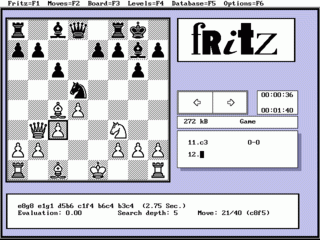
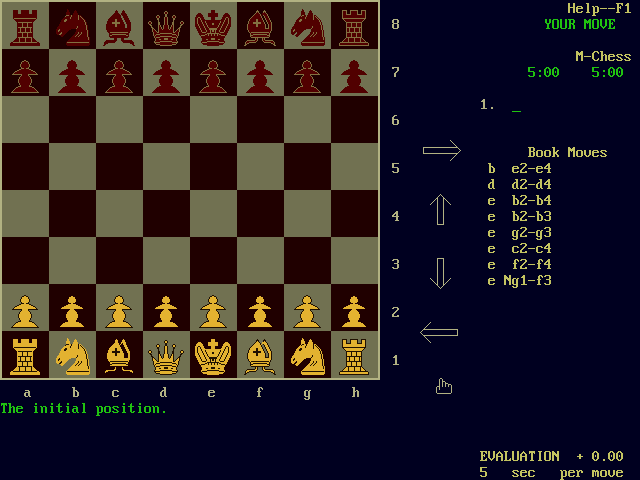
The game is played entirely against the computer and uses a text-based representation of the chessboard. Pieces are formed from letters and other ASCII characters rather than graphical sprites, with the pawns represented by character-set symbols resembling faces. The individual pieces are identified by abbreviated English names, but the board normally lacks visible coordinates. Pressing the appropriate command temporarily adds file and rank labels to help the player enter a move.
Moves are controlled exclusively through the keyboard and employ an unconventional notation. Instead of selecting a piece directly, the player enters a destination square together with an abbreviation identifying the piece to be moved. Instructions are available from within the program, but learning its commands is less intuitive than entering conventional coordinate notation. The game also lacks facilities for saving a match, and several commands provide little or no confirmation before performing their action.
The computer opponent is naturally limited by both the relatively compact BASIC program and the processing speed of early personal computers. Its calculations can require noticeable pauses, while its playing strength is modest compared with later commercial programs such as Sargon III, Cyrus or Chessmaster 2000. Nevertheless, implementing a functioning computer opponent, legal-move processing and a complete on-screen board in interpreted BASIC represented a considerable programming achievement at the beginning of the 1980s.
Chess is primarily of interest today as a historical artifact rather than as a practical way to play the game. Earlier microcomputer programs such as Peter Jennings’ Microchess already existed, so it was not the first computer chess game. However, the version prepared by Huggins appears to have been among the earliest chess programs available for the IBM PC. Its austere display and awkward controls illustrate how quickly computer chess developed from experimental BASIC listings into the polished graphical programs and powerful engines that followed later in the decade.
Text: RetroGames.cz, licensed under CC BY-SA 3.0
Controls
This is a PC game: it uses the keyboard the way it did under MS-DOS, and the mouse where the game supports it. Click the game screen first so it gets your key presses.
Many DOS games start with a menu or ask a question first — read the screen and answer with the keyboard. Arrow keys, Enter, Space, Ctrl and Alt are the usual game keys.
Live chat
Connecting…
Controls
This is a PC game: it uses the keyboard the way it did under MS-DOS, and the mouse where the game supports it. Click the game screen first so it gets your key presses.
Many DOS games start with a menu or ask a question first — read the screen and answer with the keyboard. Arrow keys, Enter, Space, Ctrl and Alt are the usual game keys.
Comments