Bionic Commando
70K plays 1987 #Action#Platform
Bionic Commando is an action platform game developed and published by Capcom for the Famicom and Nintendo Entertainment System in 1988. Although based on Capcom’s 1987 arcade game of the same name, the console version is a substantially expanded production with redesigned stages, a world map and a more elaborate storyline. The player controls a Federation soldier named Ladd, later identified within the series as Nathan “Rad” Spencer, who is sent into enemy territory to rescue the captured agent Super Joe and prevent the Badd forces from completing a secret military project known as Albatross.
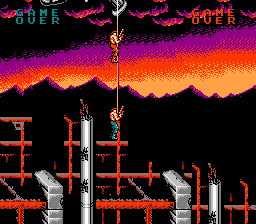
The game’s defining feature is the protagonist’s inability to jump. Instead, Ladd uses his extendable bionic arm to attach himself to ceilings and platforms, pull himself upward and swing across gaps. The arm can be fired directly forward, vertically or diagonally, and successful movement depends on choosing the correct attachment point and releasing at the proper moment. Ladd also carries firearms that can be upgraded during the mission, but learning to combine shooting with the unusual grappling system is more important than simply acquiring stronger weapons.
Progress is organized around an overhead map containing interconnected combat and neutral areas. Players travel between locations by helicopter and can often choose from several possible routes. Colliding with enemy vehicles produces short overhead shooting sequences reminiscent of Capcom’s earlier Commando. Within the main side-view stages, communication rooms allow Ladd to contact allied forces or intercept enemy messages, revealing passwords, routes and information needed to proceed. Different areas require specific communicators, weapons or equipment, while neutral zones contain useful items and characters but prohibit combat.
The Japanese version was released as Top Secret: Hitler no Fukkatsu, meaning Top Secret: The Resurrection of Hitler, and openly portrayed the enemy as a neo-Nazi organization attempting to revive Adolf Hitler. For the international editions, Nazi terminology and swastikas were removed or altered: the enemy became the Badds and Hitler was renamed Master-D. His appearance remained recognizable, however, and the unusually graphic final destruction of his face was retained. These changes make parts of the English script confusing, but they also contributed to the game’s distinctive and sometimes unsettling atmosphere.
Bionic Commando initially presents a steep learning curve, as its grappling mechanics demand greater precision than conventional platform jumping and its mission structure provides limited guidance. Once mastered, however, swinging through the stages gives the game a sense of movement unlike almost any other NES title. Its combination of action, exploration, equipment management and intercepted communications also gives the campaign considerably more depth than the arcade original. The game later became widely regarded as one of Capcom’s finest NES productions, praised especially for turning the apparent limitation of having no jump button into its most memorable and inventive feature.
Text: RetroGames.cz, licensed under CC BY-SA 3.0
Keyboard controls
| NES | Player 1 | Player 2 |
|---|---|---|
| D-pad | ↑↓←→ | IKJL |
| B | Z | N |
| A | X | M |
| Select | Shift | B |
| Start | Enter | Space |
Hotkeys
- 1 Quick save state
- 2 Quick load state
- 3 Change save slot
Gamepads are detected when you press a button. Remap any key from the emulator’s Controls menu (gear icon).
Live chat
Connecting…
Keyboard controls
| NES | Player 1 | Player 2 |
|---|---|---|
| D-pad | ↑↓←→ | IKJL |
| B | Z | N |
| A | X | M |
| Select | Shift | B |
| Start | Enter | Space |
Hotkeys
- 1 Quick save state
- 2 Quick load state
- 3 Change save slot
Gamepads are detected when you press a button. Remap any key from the emulator’s Controls menu (gear icon).


Comments