Argo Checkers
20K plays 1993 #Puzzle
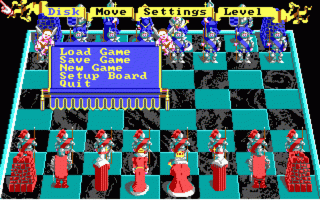
Argo Checkers plays with the standard checkers rules. Your goal is to either remove all of your opponent's pieces, or put your opponent in a situation where he or she can't move. There are two types of pieces: pawns and kings. Each side starts out with 12 pawns (black pieces in the top three rows, and red pieces in the bottom three rows) arranged on the dark squares. A pawn can only move towards the opponent's side of the board (up the screen for red, or down the screen for black). Normal moves are made by mowing one of your pieces to one of the diagonally adjacent dark squares in the appropriate direction.
Jumps are made by hopping ower an opponent's piece = when the jump is made, you capture your opponent's piece, removing it from play. If a jump is available to you, you must take it. This includes making multiple jumps (subsequent jumps made with the same piece), if they're available. Note that if you have more than one jump available, you don't have to take the jump that ends up capturing the most pieces.
Pawns are promoted to kings when you advance them to your opponent's back row (the top row onscreen for red, or the bottom row onscreen for black). A king can move freely up or down the board, for both normal moves and jumps. In fact, a king can change directions in the middle of a multiple jump. As such, kings are quite valuable = usually considered worth about one and a half times the valve of a pawn.
If you're not playing against Craniac in Hard mode, Argo Checkers assists your play by showing which pieces you can legally move in a given turn. This is done by surrounding those pieces with a blue outline, To select a piece to play, click on it. If there is only one way to move that piece, Argo Checkers will move it for you automatically. If there is more than one choice, the piece to be mowed will be surrounded by a yellow outline, with the squares you can move to outlined in green. Click on one of the green outlined squares to move your piece to that position. If you decide that you don't want to move a piece after initially selecting it, click somewhere besides the green outlined squares, and you will again be presented with the blue outlined squares indicating which pieces you can move.
If you move a piece, and decide that that move wasn't really what you wanted to do, click on the Undo button, and the board will be restored to the way it was before the move. If you then decide that you really did want to make the move, click on the Redo button, and the move will be redone. Up to 25 moves (per side) can be undone and redone. Under some circumstances, CRANIAC will offer to draw the game (admit a tie). When the Draw button shows up, you can click on it. A dialog box will come up, asking you to confirm that you really want to draw the game. If you click on Yes, the game will be drawn. When two people are playing Argo Checkers, the Draw button is always awailable.
Text: RetroGames.cz, licensed under CC BY-SA 3.0
Controls
This is a PC game: it uses the keyboard the way it did under MS-DOS, and the mouse where the game supports it. Click the game screen first so it gets your key presses.
Many DOS games start with a menu or ask a question first — read the screen and answer with the keyboard. Arrow keys, Enter, Space, Ctrl and Alt are the usual game keys.
Live chat
Connecting…
Controls
This is a PC game: it uses the keyboard the way it did under MS-DOS, and the mouse where the game supports it. Click the game screen first so it gets your key presses.
Many DOS games start with a menu or ask a question first — read the screen and answer with the keyboard. Arrow keys, Enter, Space, Ctrl and Alt are the usual game keys.
Comments