4D Prince of Persia

D
MS-DOS 0 subscribers

433K plays 1994 #Action#Platform

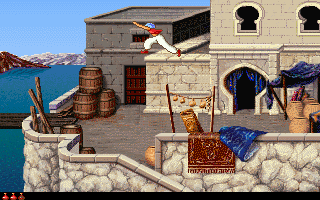
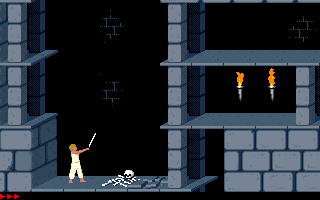
4D Prince of Persia is an unofficial modification of Jordan Mechner’s original Prince of Persia, created by Russian designer Kirill A. Terebilov for MS-DOS in 1994. Rather than being a separately programmed clone, it uses the engine and fundamental mechanics of the original game while replacing much of its level design. Terebilov created the new stages with Princedit, an early fan-made level editor released by Alexandr Larionov in 1991. The modification preserves the original story, in which the Prince must escape from prison, defeat the Grand Vizier Jaffar and rescue the Princess within sixty minutes.

Gameplay remains identical to the DOS version of Prince of Persia. The Prince runs, jumps, climbs ledges, avoids traps and fights guards with a sword, while his movements retain the unusually fluid rotoscoped animation that distinguished Mechner’s game. Progress depends on careful timing and observation as much as quick reactions: floor switches open and close gates, loose tiles collapse underfoot, and a single badly judged jump can send the Prince falling to his death. Although unsuccessful attempts cost time, the player has unlimited lives and normally restarts from the beginning of the current level.

The principal difference lies in the construction of the levels. 4D Prince of Persia begins in a relatively familiar manner but soon introduces more elaborate routes, misleading passages, dangerous jumps and stronger opposition. Some stages make deliberate use of irregular connections between rooms, creating maze-like spaces in which leaving through one side of the screen may lead somewhere unexpected. Players therefore cannot rely entirely on the knowledge acquired from the original adventure and must discover new sequences of switches, gates and passages while the same one-hour limit continues to run.

Despite its reputation as a more difficult version of Prince of Persia, the modification does not replace every part of the campaign. Several later levels remain substantially unchanged from the original game, while the redesigned sections vary considerably in complexity. The challenge is also occasionally less polished than Mechner’s carefully constructed stages: obscure routes and unconventional room connections can be confusing, and some obstacles appear designed specifically for players already familiar with advanced movement techniques and the behaviour of the original engine.

As an unofficial production, 4D Prince of Persia did not receive the conventional magazine coverage associated with a commercial release. Its historical importance instead comes from being one of the earliest substantial modifications of the DOS game, appearing long before online communities made fan-created levels commonplace. It cannot match the balance or originality of the 1989 classic, but for experienced players who have mastered the original campaign, it offers a demanding alternative built from the same elegant movement, combat and time-based structure.

Text: RetroGames.cz, licensed under CC BY-SA 3.0

Controls

This is a PC game: it uses the keyboard the way it did under MS-DOS, and the mouse where the game supports it. Click the game screen first so it gets your key presses.

Many DOS games start with a menu or ask a question first — read the screen and answer with the keyboard. Arrow keys, Enter, Space, Ctrl and Alt are the usual game keys.
Emulator help & troubleshooting

Comments

Live chat

Connecting…

Chatting as a guest · Sign in to use your name
0/300

Controls

This is a PC game: it uses the keyboard the way it did under MS-DOS, and the mouse where the game supports it. Click the game screen first so it gets your key presses.

Many DOS games start with a menu or ask a question first — read the screen and answer with the keyboard. Arrow keys, Enter, Space, Ctrl and Alt are the usual game keys.
Emulator help & troubleshooting

Save to...