The Oregon Trail
2M plays 1990 #Strategy#Educational
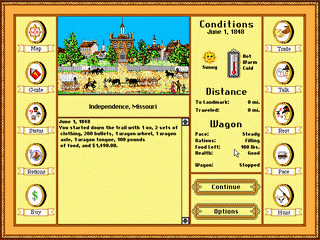
The Oregon Trail is an educational strategy game developed and published by the Minnesota Educational Computing Consortium, better known as MECC. This MS-DOS edition was released in 1990 as a conversion of the influential 1985 Apple II game designed by R. Philip Bouchard, itself a graphical reworking of a classroom program first created in 1971. The DOS conversion closely follows the design and content of the Apple II original while adapting its presentation to IBM-compatible computers.
The player leads a party of settlers travelling by covered wagon from Independence, Missouri, to Oregon's Willamette Valley in 1848. Before departure, the leader chooses to travel as a banker, carpenter or farmer and spends the available money on oxen, food, clothing, ammunition and spare wagon parts. The wealthy banker offers the easiest beginning, while the farmer starts with fewer resources but receives a larger multiplier when the final score is calculated. This choice therefore acts as an informal difficulty setting, balancing immediate security against the possibility of earning a better result.
The journey is divided into stages between real landmarks such as Chimney Rock, Fort Laramie, Independence Rock, Fort Hall and The Dalles. At forts the party can purchase supplies, while rivers require a choice between fording, caulking the wagon, paying for a ferry or waiting for safer conditions. The player also controls the travelling pace and food rations, decides when to rest and must eventually choose between the Barlow Road and rafting through the Columbia River Gorge. Conversations encountered along the route add historical observations and help connect the strategic decisions with the experiences of nineteenth-century emigrants.
Progress is repeatedly disrupted by changing weather, damaged equipment, injured oxen and illnesses including measles, cholera, typhoid and the game's famously remembered dysentery. Hunting provides additional food through a simple action sequence in which the wagon leader moves around the screen and fires in eight directions, although only a limited quantity of meat can be carried back. Reckless decisions can leave the party without food, replacement parts or enough healthy members to complete the expedition. Because many incidents occur unpredictably, even careful preparation cannot remove all risk and no two journeys develop in precisely the same way.
The DOS version uses uncomplicated colour graphics, brief sound effects and keyboard-controlled menus, but its strength lies in the interaction between preparation, chance and resource management rather than technical spectacle. Educational information and genuine geography give the journey historical context, while the unpredictable combination of accidents, disease and difficult choices makes repeated attempts play differently. Its accessible rules allow the simulation to communicate historical hardships without becoming an overly complicated management game. The more colourful and mouse-driven The Oregon Trail Deluxe followed in 1992, but this earlier edition remains one of the best-known examples of educational software becoming an enduring part of video-game culture.
Text: RetroGames.cz, licensed under CC BY-SA 3.0
Controls
This is a PC game: it uses the keyboard the way it did under MS-DOS, and the mouse where the game supports it. Click the game screen first so it gets your key presses.
Many DOS games start with a menu or ask a question first — read the screen and answer with the keyboard. Arrow keys, Enter, Space, Ctrl and Alt are the usual game keys.
Comments