Sonic The Hedgehog
0 plays 1991 #Action
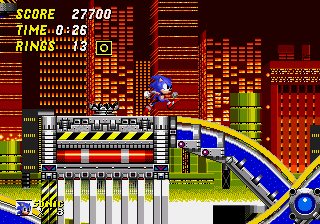
Sonic the Hedgehog is a 1991 platform game developed by Sonic Team and published by Sega for the Sega Genesis. It was released in North America and PAL regions in June and in Japan the following month. The player controls Sonic, a hedgehog who can run at supersonic speeds. The story follows Sonic as he aims to foil the mad scientist Doctor Robotnik's plans to seek the powerful Chaos Emeralds. The gameplay involves collecting rings as a form of health, and a simple control scheme, with jumping and attacking controlled by a single button.
Development began in 1990 when Sega ordered its developers to create a game featuring a mascot for the company. The developers chose a blue hedgehog designed by Naoto Ohshima of Sega R&D9 after he won an internal character design contest, and named themselves Sonic Team to match their character. It uses a novel technique that allows Sonic's sprite to roll along curved scenery which was based on a concept by Oshima from 1989. Sonic the Hedgehog, designed for fast gameplay, was influenced by games by the Mario creator, Shigeru Miyamoto. The music was composed by Masato Nakamura, bassist of the J-pop band Dreams Come True.
From Wikipedia's article Sonic the Hedgehog (1991 video game)
Keyboard controls
| Genesis | Player 1 | Player 2 |
|---|---|---|
| D-pad | ↑↓←→ | IKJL |
| A | Z | N |
| B | X | M |
| C | C | , |
| X | A | Y |
| Y | S | U |
| Z | D | O |
| Mode | Shift | B |
| Start | Enter | Space |
Hotkeys
- 1 Quick save state
- 2 Quick load state
- 3 Change save slot
X, Y and Z are for six-button games such as Street Fighter II.
Gamepads are detected when you press a button. Remap any key from the emulator’s Controls menu (gear icon).
Live chat
Connecting…
Keyboard controls
| Genesis | Player 1 | Player 2 |
|---|---|---|
| D-pad | ↑↓←→ | IKJL |
| A | Z | N |
| B | X | M |
| C | C | , |
| X | A | Y |
| Y | S | U |
| Z | D | O |
| Mode | Shift | B |
| Start | Enter | Space |
Hotkeys
- 1 Quick save state
- 2 Quick load state
- 3 Change save slot
X, Y and Z are for six-button games such as Street Fighter II.
Gamepads are detected when you press a button. Remap any key from the emulator’s Controls menu (gear icon).
4.5 Great job!
GameRankings 86%
Review scorecard
- Graphics 4.5 out of 5 Overall fallback
- Sound 4.5 out of 5 Overall fallback
- Control 4.5 out of 5 Overall fallback
- Fun Factor 4.5 out of 5 Overall fallback
Overall fallback: GameRankings 86%. Overall source The same 86/100 overall rating fills missing categories using the face scale; these are not separate category scores.
What the reviews talk about
Key wordscolourfuldetailedcatchygorgeousengagingbeautiful
What the critics said
In a preview following its CES debut in January 1991, John Cook of Computer and Video Games called it the most impressive game at the show and said it was "another jumpy jumpy game in the Mario mould, but with an astonishing turn of speed and great music."
— Computer and Video Games, 1991 (John Cook)
Julian Boardman of Raze praised the "colourful and highly detailed" backdrops and "fabulous" sprites.
— Raze, 1991 (Julian Boardman)
From the Reception section of Wikipedia's Sonic the Hedgehog (1991 video game) article.
Scores
- 100 Dragon 5/5
- 100 Entertainment Weekly A+
- 98 Joystick1991 98%
- 97 Génération 41991 97%
- 97 Sega Power1991 97%
- 96 ACE1991 925/1000 ; 5/5
- 96 GamePro1991 24/25
- 96 Player One1991 96%
- 95 HobbyConsolas1991 95%
- 95 Raze 95%
- 94 Computer and Video Games 94%
- 93 Beep! MegaDrive1991 37/40
- 92 Mean Machines1991 92%
- 90 Electronic Gaming Monthly 9/10, 9/10, 9/10, 9/10
- 83 Famitsu1991 8/10, 8/10, 9/10, 8/10
- 90 Eurogamer2007 9/10 · other versions
- 80 IGN2007 8/10 · other versions
- 80 Nintendo Life2006 8/10 · other versions
- 49 GameSpot2006 2.5/10; 7.3/10 · other versions
From the review table in Wikipedia's Sonic the Hedgehog (1991 video game) article.
Comments