Sid Meier’s Civilization
1.2M plays 1991 #Strategy
Sid Meier’s Civilization is a turn-based strategy game designed by Sid Meier with significant contributions from Bruce Shelley and developed and published by MicroProse in 1991. Originally created for MS-DOS, it established the central idea expressed by its famous slogan: to build an empire that can stand the test of time. Beginning in 4000 BC, the game follows a chosen people from its first settlement through antiquity, industrialisation and the modern age, potentially ending with a voyage to another star. The combination of exploration, expansion, resource management and warfare later became widely described as the 4X formula, and Civilization became one of its defining examples. Versions followed for the Amiga, Atari ST, Macintosh, Windows, PlayStation, Saturn and other systems, including a substantially adapted Super Nintendo edition.
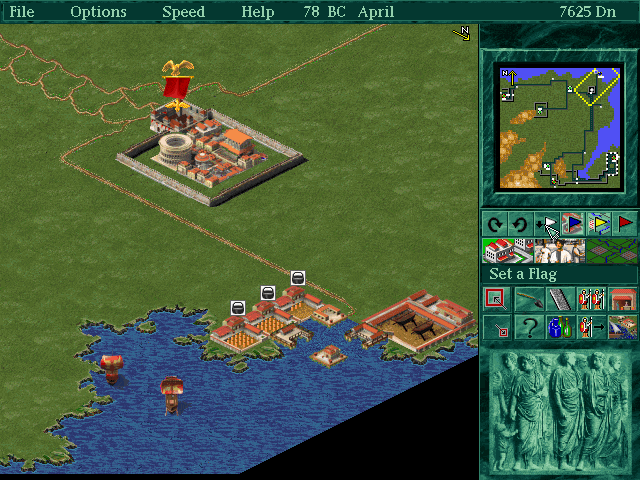
The player begins with one or occasionally two settler units and competes against between two and seven computer-controlled civilizations. Settlers found cities, which convert food, production and trade from the surrounding terrain into population growth, military units, buildings, scientific research and tax revenue. Each turn therefore involves decisions on several scales: where to expand, what every city should produce, how much income to devote to science or luxuries, and whether neighbouring powers should be treated as trading partners or enemies. Barbarians emerging from unsettled land and sea add an independent threat, although the space available to them gradually shrinks as the world is colonised.
Before play begins, one of fourteen historical civilizations is selected, including the Americans, Aztecs, Indians, Mongols and Romans. Compared with later entries in the series, the differences are modest: the choice determines the leader, ruler titles, city names, colour and musical herald, while computer-controlled peoples also display characteristic behaviour. On the fixed Earth map it also determines the starting region and therefore the nearby terrain and resources; on randomly generated or customised worlds, starting positions are assigned independently. Because civilizations are paired by colour, both members of the same colour group cannot appear in a single game.
Expansion is inseparable from changing the land itself. Settlers can irrigate fertile areas, construct mines, clear or plant forests and join cities with roads; later, railroads provide effectively unlimited movement along completed connections. The best location for a city must balance food, production, trade, defence and access to the sea, and a poor early decision can remain costly for thousands of in-game years. Governments ranging from despotism and monarchy to republic, democracy and communism alter taxation, corruption, military support and public order, forcing successful rulers to adapt their administration as the empire grows.
Scientific progress provides the structure linking the different eras. Early discoveries such as pottery, the alphabet and the wheel lead through a branching technology tree to railroads, flight, nuclear fission and space travel. Most advances unlock new units, city improvements, governments or further research options: the wheel permits chariots, for example, while pottery allows granaries. Only one advance can normally be researched at a time, so its selection has major strategic consequences. Concentrating on military discoveries may provide a temporary advantage, whereas economic and scientific development can accelerate every later stage of growth.
Cities may also construct Wonders of the World after acquiring the necessary knowledge. The Pyramids, Great Wall, Hanging Gardens, Copernicus’ Observatory, Magellan’s Expedition, Darwin’s Voyage, United Nations, Apollo Program and Manhattan Project are costly projects that can be completed only once in the entire world. Their benefits may affect one city, a continent or the whole civilization, and some disappear when later discoveries make the wonder obsolete. Diplomacy adds another layer through meetings, treaties and exchanges of knowledge, while diplomat units can establish embassies, investigate or sabotage cities and even incite an enemy settlement to revolt. Naval expansion is equally important on divided maps, although early triremes risk sinking if they finish a turn away from the coast.
Victory can be achieved by eliminating every rival civilization or by constructing a spacecraft whose colonists successfully reach Alpha Centauri. If neither occurs, scoring ends between AD 2100 and 2020 depending on the selected difficulty, and the player’s achievements are judged against those of famous historical rulers. The original release is entirely single-player; network and hot-seat multiplayer arrived with the 1995 remake Sid Meier’s CivNet. Civilization’s enormous scope, interlocking systems and ability to generate a different history in every game made it one of the most influential strategy titles ever created, while the familiar temptation to play just one more turn helped establish a series that continued for decades.
Text: RetroGames.cz, licensed under CC BY-SA 3.0
Controls
This is a PC game: it uses the keyboard the way it did under MS-DOS, and the mouse where the game supports it. Click the game screen first so it gets your key presses.
Many DOS games start with a menu or ask a question first — read the screen and answer with the keyboard. Arrow keys, Enter, Space, Ctrl and Alt are the usual game keys.
Comments