Populous
42K plays 1989 #Simulation
Populous is a video game developed by Bullfrog Productions and published by Electronic Arts for the Amiga in March 1989, then quickly the Atari ST and MS-DOS. Many conversions followed, including for the Genesis, Super NES, and PC Engine consoles. Populous is considered the first god game. With over four million copies sold, Populous is one of the best-selling PC games of all time.
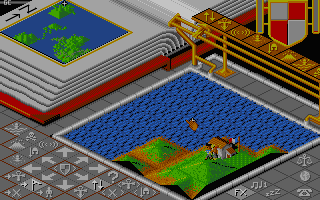
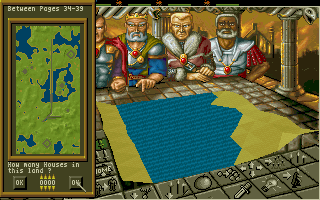
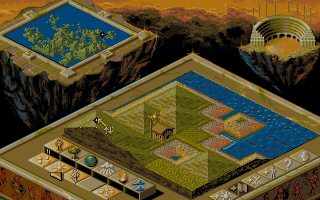
The player assumes the role of a deity, who must lead followers through direction, manipulation, and divine intervention, with the goal of eliminating the followers led by the opposite deity. Played from an isometric perspective, the game consists of more than 500 levels, with each level being a piece of land which contains the player's followers and the enemy's followers. The player is tasked with defeating the enemy followers and increasing their own followers' population using a series of divine powers before moving on to the next level. The game was designed by Peter Molyneux, and Bullfrog developed a gameplay prototype via a board game they invented using Lego.
From Wikipedia's article Populous (video game), licensed under CC BY-SA 4.0
Controls
This is a PC game: it uses the keyboard the way it did under MS-DOS, and the mouse where the game supports it. Click the game screen first so it gets your key presses.
Many DOS games start with a menu or ask a question first — read the screen and answer with the keyboard. Arrow keys, Enter, Space, Ctrl and Alt are the usual game keys.
Live chat
Connecting…
Controls
This is a PC game: it uses the keyboard the way it did under MS-DOS, and the mouse where the game supports it. Click the game screen first so it gets your key presses.
Many DOS games start with a menu or ask a question first — read the screen and answer with the keyboard. Arrow keys, Enter, Space, Ctrl and Alt are the usual game keys.
3.0 Good job
Players 74 · 86 votes
No critic scores found for this game: this is the players' rating.
Review scorecard
- Graphics 3.0 out of 5 Overall fallback
- Sound 3.0 out of 5 Overall fallback
- Control 3.0 out of 5 Overall fallback
- Fun Factor 3.0 out of 5 Overall fallback
Overall fallback: Players 74 · 86 votes. The same 74/100 overall rating fills missing categories using the face scale; these are not separate category scores. Player rating; no critic scores available.
What the reviews talk about
Key wordscreativecolourfulcuterepetitivechallengingaddictive
What the critics said
Biff Kritzen of Computer Gaming World gave the game a positive review, noting, "as heavy-handed as the premise sounds, it really is a rather light-hearted game."
— Computer Gaming World (Biff Kritzen)
MegaTech magazine stated that the game has "super graphics and 500 levels. Populous is both highly original and amazingly addictive, with a constant challenge on offer".
— MegaTech
Orson Scott Card in Compute! criticized the game's user interface, but praised the graphics and the ability to "create your own worlds... you control the world of the game, instead of the other way around".
— Compute!, 1989 (Orson Scott Card)
From the Reception section of Wikipedia's Populous (video game) article, under CC BY-SA 4.0. The words are the critics'; their full reviews are on the publishers' pages.
Scores
- Dragon 5/5 (DOS)
- Computer and Video Games 1989 96% (Amiga) (other versions)
- Famitsu 7/10, 9/10, 9/10, 5/10 (SNES) ; ; 6/10, 7/10, 9/10, 6/10 (PC Engine) (other versions)
- Raze 1990 89% (Mega Drive) (other versions)
- Zero 1992 92% (Amiga) (other versions)
- Computer Gaming World 1993 3/5 (DOS/Amiga)
- Console XS 1992 88% (Master System) (other versions)
- Games International 1989 2/5
- MegaTech 1992 91% (Mega Drive) (other versions)
- Your Amiga 1989 93% (Amiga) (other versions)
- ST/Amiga Format 1989 92% (Amiga) ; (other versions)
From the review table of Wikipedia's article. The face takes, first that applies: the Metascore for this platform, GameRankings' average, our average of the critics (one number per publication, a panel averaged), one review alone, the players' rating. Critics and players are never mixed.
Comments