Mind Mirror
0 plays 1986 #Simulation
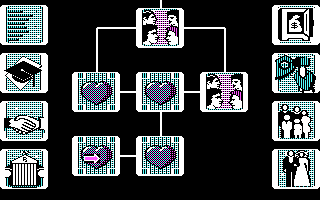
Timothy Leary's Mind Mirror is a video game developed by Futique, the studio of Timothy Leary, and published in 1985 by Electronic Arts for the Atari 8-bit computers. It was ported to the Apple II, Commodore 64, and IBM PC compatibles (as a self-booting disk). The game sold well, but received mixed reviews, with critics expressing varied opinions on the scope and applications of the game's psychological features and user-friendliness of the software's design.
Contemporary and retrospective reception has assessed the game as an unusually experimental title for early computer games, with comparisons drawn to Alter Ego (1986), a simulation game with a similar premise. Plans by Leary to create a sequel, Head Coach, never came to fruition.
From Wikipedia's article Timothy Leary's Mind Mirror
Controls
This is a PC game: it uses the keyboard the way it did under MS-DOS, and the mouse where the game supports it. Click the game screen first so it gets your key presses.
Many DOS games start with a menu or ask a question first — read the screen and answer with the keyboard. Arrow keys, Enter, Space, Ctrl and Alt are the usual game keys.
Live chat
Connecting…
Controls
This is a PC game: it uses the keyboard the way it did under MS-DOS, and the mouse where the game supports it. Click the game screen first so it gets your key presses.
Many DOS games start with a menu or ask a question first — read the screen and answer with the keyboard. Arrow keys, Enter, Space, Ctrl and Alt are the usual game keys.
No reviews yet
We found no critic scores for this game, and too few players have rated it.
Review scorecard
- Graphics — Not scored Unavailable
- Sound — Not scored Unavailable
- Control — Not scored Unavailable
- Fun Factor — Not scored Unavailable
No category score or overall rating is available for the unscored slots.
What the reviews talk about
Key wordsentertainingflawedfunrepetitive
What the critics said
Although noting the program was "not for everyone" and could be "intimidating" at first, Computer Entertainer considered the game had a "tremendous amount of freedom to explore feelings and concepts in ways that are open ended".
— Computer Entertainer, 1986
Scott Thomas of Compute! felt the game was "entertaining and insightful" and examples of a "serious non-business application" for the home computer beyond the traditional video game, also identifying its potential for use as a party game.
— Compute!, 1987 (Scott Thomas)
From the Reception section of Wikipedia's Timothy Leary's Mind Mirror article.
Comments