Mickey Mouse

190K plays 1991 #Action#Platform
Mickey Mouse is an action-puzzle video game developed by Kemco and released for the Nintendo Game Boy in Europe in 1992. It is the European version of The Bugs Bunny Crazy Castle 2, and was originally released in Japan as Mickey Mouse II on April 26, 1991. In North America, the game was released under the title The Bugs Bunny Crazy Castle 2 in September 1991, while a later European re-release featuring the Danish media character Hugo was issued in 1995. The title is part of Kemco’s Crazy Castle series, a long-running franchise of licensed action-puzzle games adapted to regional character licenses.
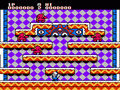
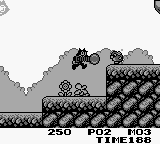
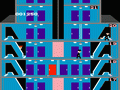
In Mickey Mouse, the player controls Mickey Mouse as he navigates a haunted castle to rescue Minnie from the villainous Horned King. Each of the game’s 28 levels presents a single-screen puzzle environment in which the player must collect a set number of keys before unlocking the exit door and advancing to the next stage. Mickey cannot jump in the traditional platforming sense; instead, he must use environmental features such as stairs, slides, pipes, and warp passages to reach out-of-the-way areas or avoid enemies.
Gameplay emphasizes exploration and planning rather than reflex-based action. Enemies roam the castle corridors with distinct movement patterns, and the player must time movements carefully to avoid collisions, as Mickey can typically only take one hit before losing a life. Items such as arrows and bombs may be used to neutralize certain foes, while objects like crates, chests, and hammers are used to eliminate obstacles or create paths. Many levels also feature warp doors that both facilitate movement and briefly freeze enemies upon entry or exit, adding a light tactical element to progression.
The game’s design has been noted for its blend of action and puzzle elements, with reviewers highlighting its surprisingly deep level layouts and increasing challenge across stages. Some criticism has been directed at occasional slowdown when multiple enemies and objects appear simultaneously, but the game’s responsive controls and well-considered use of environmental navigation have generally been regarded positively. Although stylistically simple compared to later handheld titles, Mickey Mouse is viewed as an engaging example of early Game Boy puzzle design.
Mickey Mouse is part of a broader trend in the Crazy Castle series of re-theming the same underlying game engine for different licensed characters and regions. The North American The Bugs Bunny Crazy Castle 2 featured Looney Tunes characters such as Yosemite Sam and Daffy Duck in place of Disney characters, while another European variation was released under the title Hugo with entirely different character sprites and theming. These adaptations illustrate how early handheld games were localized not just through language but by swapping out entire casts to suit regional licenses.
Text: RetroGames.cz, licensed under CC BY-SA 3.0
Keyboard controls
| Game Boy | Player 1 |
|---|---|
| D-pad | ↑↓←→ |
| B | Z |
| A | X |
| Select | Shift |
| Start | Enter |
Hotkeys
- 1 Quick save state
- 2 Quick load state
- 3 Change save slot
Gamepads are detected when you press a button. Remap any key from the emulator’s Controls menu (gear icon).
Live chat
Connecting…
Keyboard controls
| Game Boy | Player 1 |
|---|---|
| D-pad | ↑↓←→ |
| B | Z |
| A | X |
| Select | Shift |
| Start | Enter |
Hotkeys
- 1 Quick save state
- 2 Quick load state
- 3 Change save slot
Gamepads are detected when you press a button. Remap any key from the emulator’s Controls menu (gear icon).
Comments